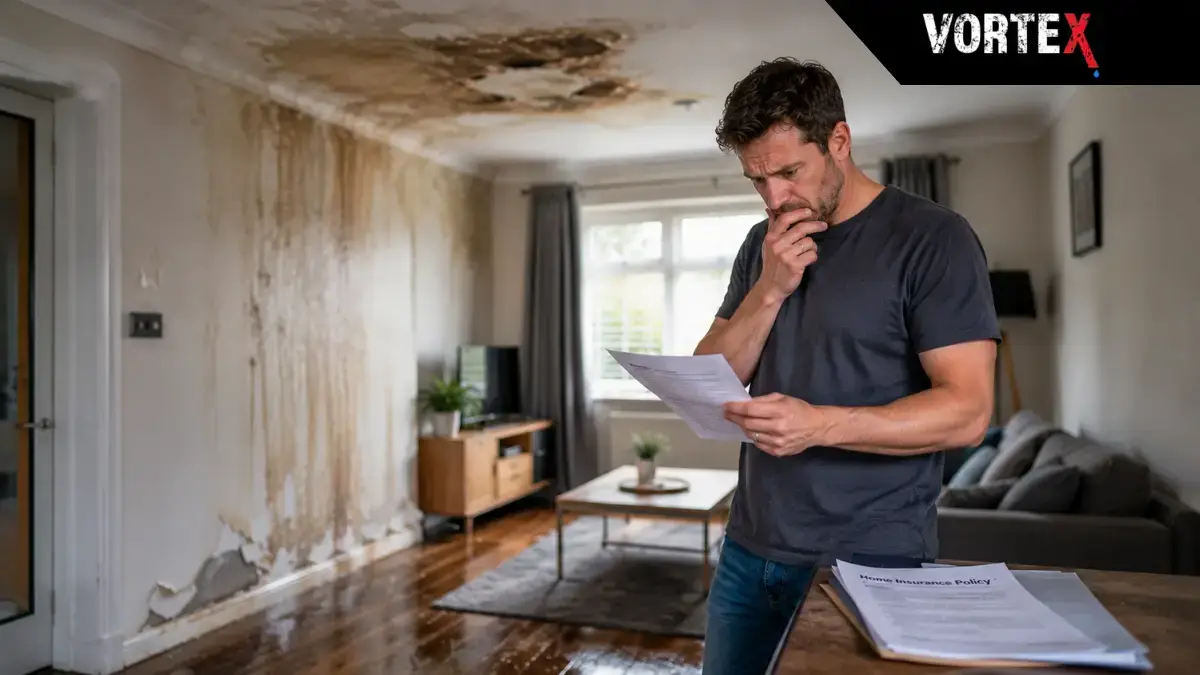

Mould on walls is one of the most alarming discoveries a homeowner makes, and one of the most misdiagnosed. The immediate assumption is almost always the same: poor ventilation, too much moisture in the air, not enough heating. This is sometimes correct. But it is not always correct, and when the real cause is a hidden water leak rather than condensation, the assumption leads to a cycle of treatment and recurrence that resolves nothing while the underlying problem gets worse.
Condensation mould and leak-caused mould look similar at first glance. Both are black or dark green. Both grow on walls. Both smell musty. The difference lies in where they grow, how they behave over time, and whether they respond to ventilation improvements. Understanding those differences is what determines whether the right response is a dehumidifier and better ventilation management, or a specialist water leak investigation.
This article explains the three sources of wall mould, how to distinguish condensation mould from mould caused by a hidden leak, the location and pattern tests you can apply, and when the evidence points clearly toward a specialist investigation being the appropriate next step.
| Quick AnswerMould on walls from condensation typically appears high on walls, in corners, and around windows. It improves when ventilation increases. Mould from a hidden water leak appears at low levels, behind fitted units, or in areas with no obvious condensation source, and does not improve with ventilation. If mould keeps returning after treatment, the moisture source has not been removed and a hidden leak should be investigated. |
Why Mould on Walls Is Not Always a Ventilation Problem
The ventilation explanation for wall mould is so commonly given that it has become an assumption. Surveyors note it. Lettings agents advise tenants about it. Manufacturers of dehumidifiers build their marketing around it. In many cases it is accurate. But the simplicity of the explanation creates a real risk of misdiagnosis when the actual cause is something else entirely.
Mould requires moisture. When that moisture comes from the air condensing on cold surfaces due to poor ventilation, improving ventilation removes the moisture source and the mould stops returning. But when that moisture comes from water escaping from a pipe inside the wall, beneath the floor, or above the ceiling, no amount of ventilation management will remove the moisture source. The pipe continues to leak. The building material continues to absorb water. The mould continues to grow.
The cycle of treating mould, watching it return, treating it again, and concluding that the problem is simply a poorly ventilated property is one of the most common hidden leak scenarios. The mould is not the problem. It is a symptom of the problem. Treating the symptom without identifying the cause is not a solution.
Three Sources That Cause Mould on Walls
Condensation from Inadequate Ventilation
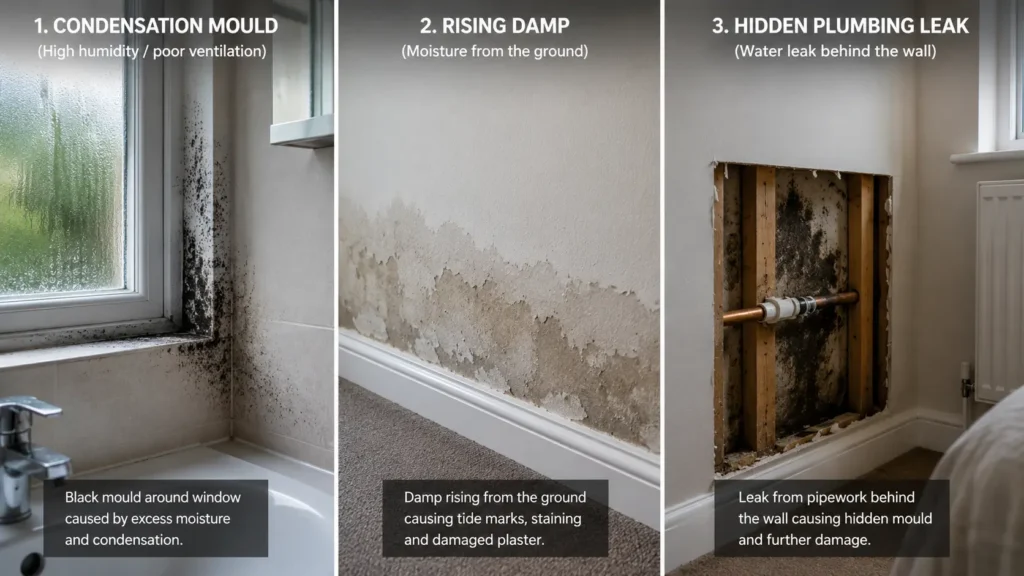
Condensation forms when warm, moisture-laden air meets a surface that is cool enough to drop the air below its dew point. The moisture condenses onto the surface and, if that surface remains damp for prolonged periods, mould establishes itself. Condensation mould is most common in bathrooms, kitchens, bedrooms, and rooms with poor ventilation, and is closely associated with everyday moisture-generating activities: cooking, showering, drying clothes indoors, and breathing.
In a well-managed property with adequate ventilation and consistent heating, condensation mould is controllable. In a poorly insulated, poorly ventilated, or intermittently heated property it can be persistent. The key characteristic is that it responds to changes in ventilation and heating. If you open windows, run extractor fans consistently, and maintain a base level of background heating, condensation mould retreats.
Rising or Penetrating Damp
Rising damp occurs when ground moisture travels upward through porous masonry, typically in properties with a failed or absent damp-proof course. It produces a characteristic tide mark on lower walls and tends to be more consistent and less seasonally variable than condensation. Penetrating damp enters from outside through cracks, failed pointing, or inadequate weatherproofing. Both are distinct from water leak causes and are typically assessed by a specialist damp surveyor.
Hidden Water Leaks from Plumbing or Heating Pipes
A hidden water leak inside a wall, beneath a floor, or above a ceiling releases water continuously into the surrounding building fabric. That moisture has no route to evaporate because it is enclosed within the structure. Over time it saturates the plasterboard, timber, or masonry in the affected zone. When the moisture content of the wall material remains above a threshold for a sustained period, mould establishes itself. It may grow on the surface, or it may grow within the wall structure before it becomes visible.
This type of mould is fundamentally different from condensation mould in its origin and in its behaviour. It is not caused by moisture in the air. It is caused by moisture within the building fabric. Ventilation improvements do not reach the source. Surface treatments address the mould but not the conditions that allow it to grow. The only effective resolution is finding and fixing the leak.
Condensation, Surface Leak, or Hidden Leak: Key Differences at a Glance
| Feature | Condensation Mould | Surface Leak Mould | Hidden Leak Mould |
| Typical location | High on walls, corners, around windows, cold surfaces | Directly below or adjacent to a visible leak source | Low on walls, behind units, around pipe routes, or in unexpected locations |
| Responds to ventilation? | Yes, typically improves significantly | No | No |
| Visible moisture source? | Condensation on windows and surfaces | Yes, visible drip or wet patch from source | No visible source of moisture |
| Returns after treatment? | Only if ventilation not improved | Only while source is active | Yes, consistently, until leak is fixed |
| Musty smell strength | Moderate, associated with damp surface | Variable | Often strong, earthy, damp-basement character |
| Boiler pressure dropping? | No | Possibly if heating pipe | Often yes if heating circuit involved |
| Seasonal pattern? | Worse in winter | Related to usage of water source | No seasonal pattern, worsens over time |
| Appropriate response | Improve ventilation, heating, moisture management | Find and repair visible source | Specialist leak investigation |
What Does Condensation Mould Look Like?
Condensation mould has a recognisable set of characteristics. It typically appears as black or dark green spots or patches on wall surfaces, often starting as a diffuse spray of small dots that merge over time. It is most common at the high points of walls, where they meet the ceiling, in corners where two walls meet and airflow is poor, and around window frames and reveals where the surface temperature is lowest.
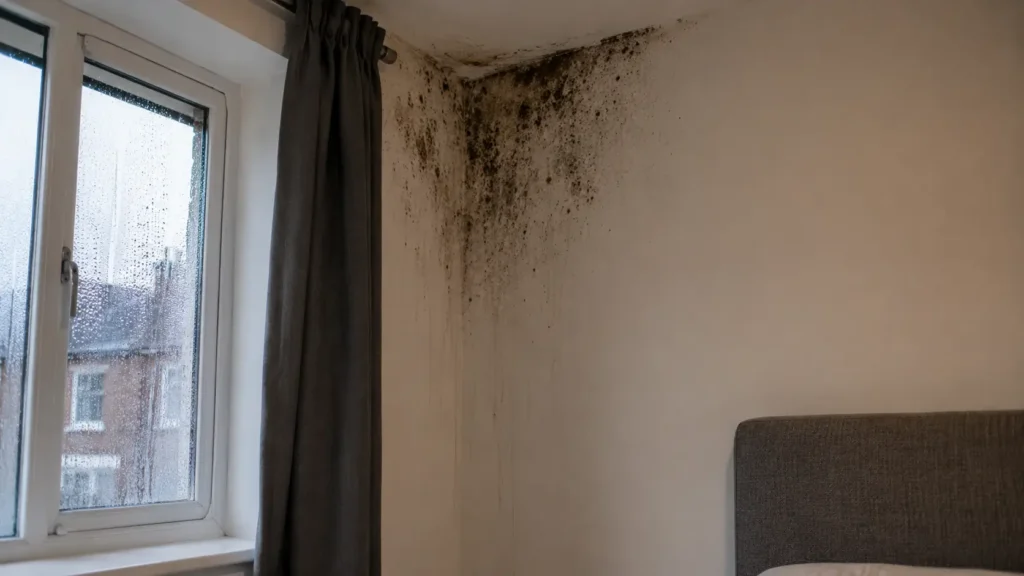
In bathrooms it appears on the ceiling, on grouting around baths and showers, on window frames, and on the wall areas that get consistently wet and then remain humid. In kitchens it appears above and around cooking areas and on the ceiling. In bedrooms it appears in corners and on the wall furthest from the heat source, particularly in rooms occupied overnight when moisture from breathing is highest.
Condensation mould responds visibly to changes in behaviour and ventilation. A bathroom where an extractor fan is consistently used during and after showering will show a reduction in mould compared with the same bathroom with the fan turned off. This responsiveness is one of the clearest diagnostic indicators that condensation rather than a hidden leak is the primary cause.
What Does Mould from a Hidden Water Leak Look Like?
Mould caused by a hidden water leak shares the same dark colouration as condensation mould but differs in its location, its extent, and its behaviour. Because it is fed by moisture from within the building fabric rather than from the air, it often appears in locations that seem wrong for condensation: low on a wall where condensation would not typically form, in a warm room where condensation is unlikely, or on an internal wall that is not a cold external surface.
Mould from a hidden leak may grow more aggressively in a defined zone that corresponds to the area of saturated building material above the leak point. It may appear on the back of fitted furniture or behind units that have been against the wall for years, where there was no previous mould. It can grow on the underside of floor coverings or on timber elements close to floor level.
Critically, mould from a hidden leak does not respond to ventilation improvements. You can open windows, run extractor fans, and maintain consistent heating for weeks, and the mould returns or continues to grow. This persistence despite ventilation measures is one of the strongest single indicators that the moisture source is not condensation.
The Location Test: What Position on the Wall Tells You
High on Walls and in Corners: More Likely Condensation
Warm moist air rises and condensation forms preferentially at the coldest points in a room, which are typically the highest surfaces and the corners where airflow is most restricted. Mould appearing at ceiling height, in the upper corners of rooms, or on the top sections of external walls in bedrooms and living rooms is almost always condensation-related. The question is whether the ventilation can be improved to manage it.
Low on Walls Near Skirting or at Floor Level: More Likely a Leak
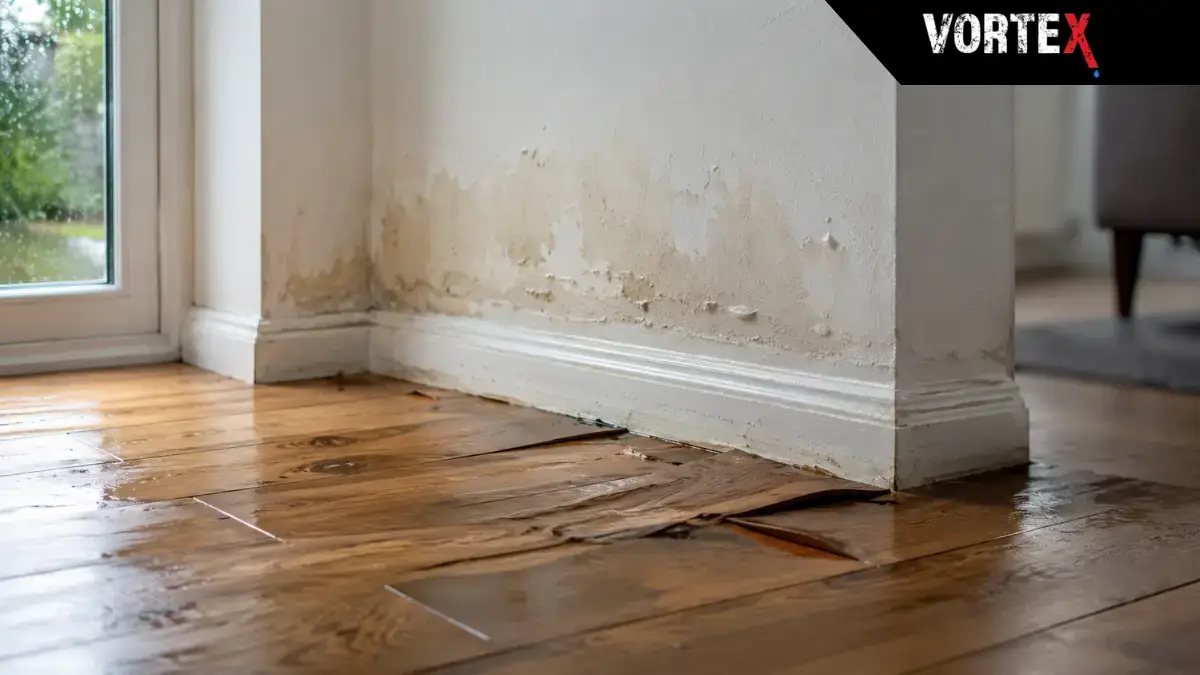
Mould appearing at the bottom of walls, close to the skirting board, or at floor level is significantly less consistent with condensation as a primary cause. Cold air sinks but moisture in the air is more evenly distributed, and condensation mould at low level is less typical than at high level. Mould at skirting level on an internal wall, particularly one where the heating circuit runs or where a supply pipe is buried, is more consistent with a hidden leak that has saturated the lower section of the wall structure.
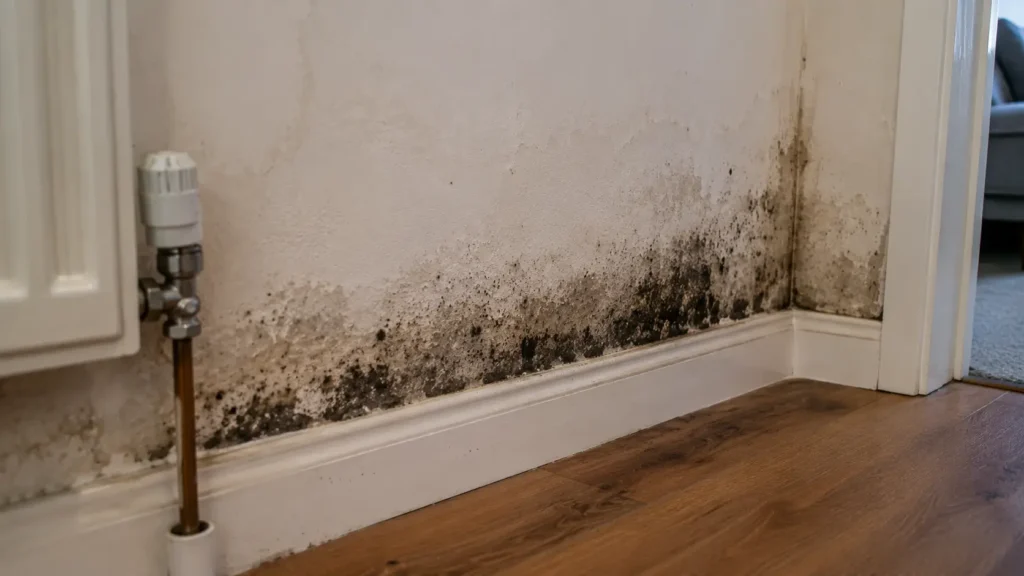
Behind Fitted Units or on Concealed Surfaces: High Leak Suspicion
Mould appearing behind kitchen base units, behind bathroom panels, or on the back surfaces of fitted wardrobes that have been in place for years suggests moisture within the wall structure rather than condensation on the surface. Condensation cannot form on surfaces that are sealed from airflow. Moisture from within the wall can saturate material on both sides of the surface, including the concealed side. Mould in these locations warrants a thorough investigation of whether a water pipe runs in the adjacent wall.
The Pattern Test: How Mould From a Leak Behaves Differently
Beyond location, the pattern of growth and the behaviour of the mould over time carries important diagnostic information.
Condensation mould grows in the areas of highest moisture and lowest temperature. Its pattern reflects the airflow and temperature distribution of the room. It tends to be more broadly distributed, appearing in multiple areas simultaneously when conditions are poor, and reducing across all affected areas when ventilation improves.
Mould from a hidden leak grows outward from the source of the moisture within the wall. Its pattern is more localised and concentrated in the zone above the leak. As the saturation spreads through the building material, the visible mould expands outward from that centre. The growth is progressive rather than seasonal, and it does not reduce when ventilation improves because the moisture source is not ventilation-dependent.
Another key pattern difference is the speed of return after treatment. Condensation mould that is cleaned and then supported by improved ventilation may not return for weeks or may return only partially. Mould from a hidden leak may return visibly within days of surface treatment because the moisture driving it is still present at full force within the wall.
Why Mould from a Hidden Leak Keeps Coming Back
This is the question most homeowners with a hidden leak eventually ask: why does the mould keep returning no matter what I do?
The answer is that surface mould treatment and ventilation management address the visible symptom. They do not affect the underlying moisture condition within the building material. When a hidden leak is continuously adding water to the surrounding structure, the moisture content of the wall remains permanently elevated. Surface evaporation and ventilation can reduce the moisture at the wall surface temporarily, which allows treatment to visibly clear the mould, but the moisture level returns as the water continues to migrate from the saturated zone behind.
A mould treatment product kills the mould present at the time of application. It does not prevent new mould from establishing when the conditions for growth return. If those conditions are maintained by a continuous source of moisture within the wall, the mould returns. This is why recurring mould that does not respond to standard management over a period of weeks to months is one of the strongest practical indicators that a hidden leak investigation is warranted.
Can Mould Appear Before There Is Any Visible Damp?
Yes, and this is a critically important point that many homeowners are not aware of. A hidden water leak can create the moisture conditions for mould growth within the building fabric before the wall surface itself shows any visible damp patch. The moisture saturation begins deep within the wall material and works outward. Mould establishes itself in the saturated zone before the surface moisture reaches a level that is visible to the eye.
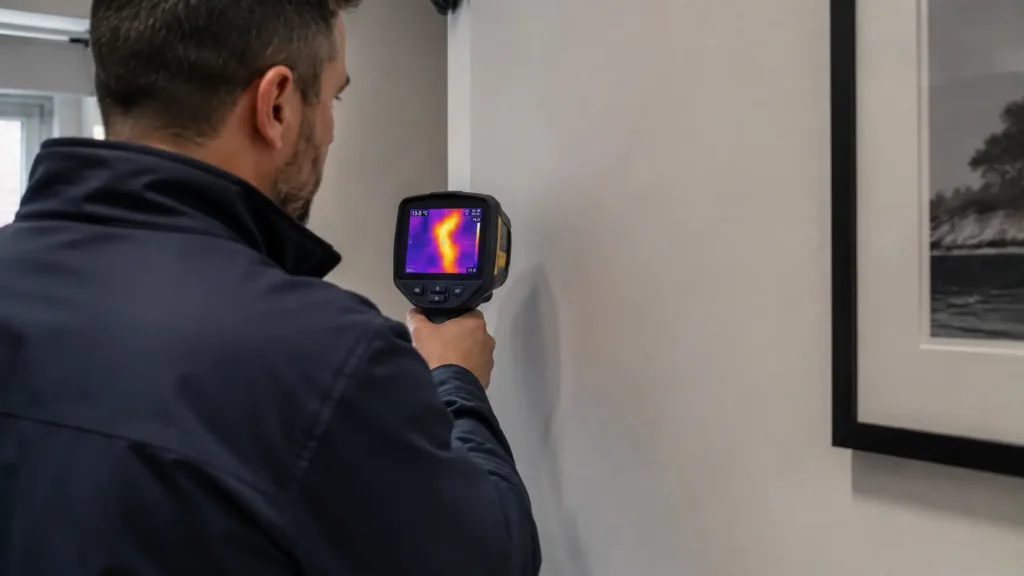
The result is a wall that looks dry to the eye and dry to the touch at its surface but has a high moisture content within its structure, supporting active mould growth that eventually becomes visible as the saturation progresses. In these situations the homeowner sees mould appearing on what appears to be a dry wall and concludes that condensation, not a leak, must be the cause because there is no visible damp.
A moisture meter can confirm this scenario. A reading taken at the wall surface may show an elevated moisture level even when the surface looks and feels dry. A thermal imaging camera can show the moisture pattern within the wall. These are the specialist tools that distinguish between what the eye can see and what is actually happening within the building fabric.
The Health Dimension: When Mould Becomes a Serious Concern
Mould produces spores that become airborne and are inhaled by occupants. For most healthy adults, low-level mould exposure is an irritant rather than a serious health threat. However, for people with respiratory conditions such as asthma, chronic obstructive pulmonary disease, or allergies, for young children, for elderly people, and for those with compromised immune systems, mould exposure can trigger or worsen respiratory symptoms.
The significance for leak-caused mould is that it tends to be more extensive and more persistent than condensation mould. Because it is fed by a continuous moisture source, it can colonise a larger area of building material and maintain a higher spore load over a longer period. Addressing the visible surface mould while the hidden leak continues does not meaningfully reduce the health exposure from the affected area.
If any occupant is experiencing respiratory symptoms that improve when away from the property and worsen on return, and mould is present, addressing the root cause of the mould is a health priority as well as a property maintenance one.
What to Do If You Have Already Treated the Mould and It Has Returned
If you have cleaned the mould, improved ventilation, maintained consistent heating, and the mould has returned within a few weeks, the diagnosis of condensation as the sole cause should be questioned. The treatment protocol for condensation mould is well-established and effective when condensation is genuinely the cause. Mould that returns despite sustained correct management of ventilation and heating is telling you the moisture source is not in the air.
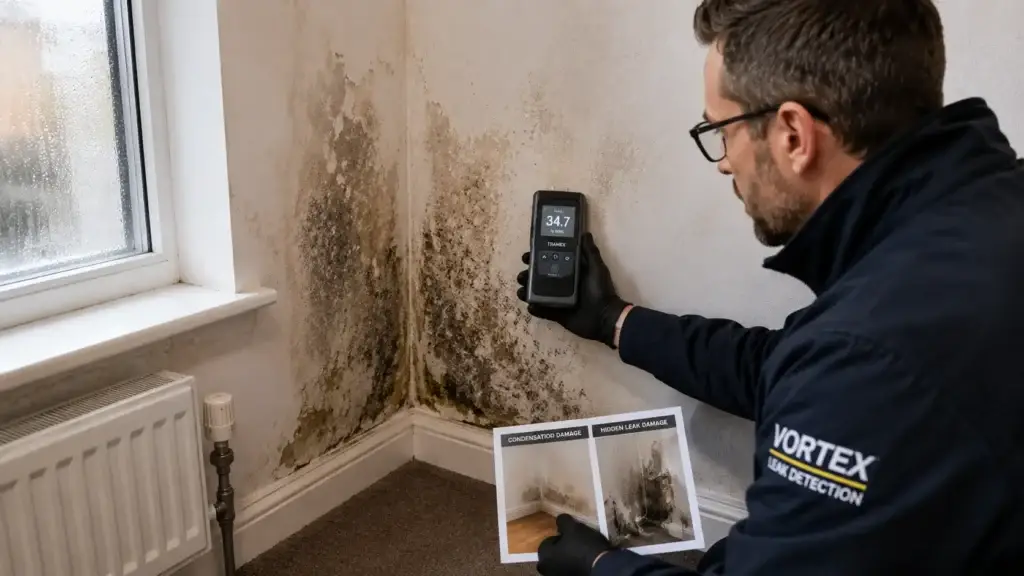
At this point the most productive next step is to assess whether a hidden water leak is involved. A moisture meter reading at the affected wall area can confirm whether the building material is elevated in moisture content beyond what condensation alone would produce. If it is, specialist investigation is the appropriate response.
Do not continue with mould treatment cycles that do not resolve the problem. Each cycle confirms that the surface symptom is being managed temporarily, not that the cause has been addressed.
Quick Diagnostic Checklist: Condensation or Hidden Leak?
| A hidden leak is the more likely cause of wall mould if:The mould appears at low level on a wall, near skirting boards, or at floor levelThe mould appears in a warm room where condensation would not typically formThe mould grows on an internal wall rather than an external-facing surfaceThe mould appears behind fitted kitchen or bathroom unitsThe mould returns within days or weeks of surface treatment despite improved ventilationVentilation and heating improvements have had no noticeable effect on the mouldA musty, earthy smell is present in the room even when the mould has been cleanedThe boiler is losing pressure repeatedly without a clear component faultA high water bill or moving overnight meter reading has also been noticedThe same wall shows recurrent mould in exactly the same location despite repeated treatment |
| Condensation is the more likely cause if:The mould appears high on walls, at ceiling level, or in the upper corners of roomsIt is most severe in winter and noticeably reduces in summerIt is worst in bathrooms, kitchens, and bedrooms with high moisture generationVisible condensation appears on windows and cold surfaces in the same areaThe mould has reduced when ventilation has been consistently improvedThere is no associated pressure loss on the boiler or high water bill |
When Should You Arrange a Specialist Leak Investigation?
A specialist leak investigation is appropriate when any of the following apply alongside recurring wall mould.
- The mould returns within a few weeks of cleaning despite consistent ventilation improvements
- The mould is positioned at low wall level, behind units, or in a location inconsistent with condensation
- A moisture meter reading on the affected wall shows elevated moisture content
- The boiler is also losing pressure without an identified component fault
- A high water bill or overnight meter movement has been noticed
- The property has a history of plumbing issues or is more than twenty-five years old
- A surveyor or building professional has suggested that a leak may be involved
What to Do Next
If recurring mould on your walls has not responded to ventilation management and surface treatment, a specialist leak investigation is the most effective next step. The Vortex Leak Detection team uses thermal imaging and moisture detection equipment to assess whether elevated moisture in a wall or floor structure is consistent with a hidden leak, and to locate the source if it is.
Continuing to treat the surface without addressing the cause wastes time, costs money, and allows the underlying damage to the building fabric to accumulate. Get in touch at vortexleakdetection.co.uk/contact-us-vortex/ to discuss your situation and arrange an assessment.
| Mould that returns is mould that has a source you have not yet found.If ventilation improvements and surface treatment have not resolvedrecurring wall mould, the moisture source may be a hidden water leak.Contact Vortex Leak Detection to investigate the cause.vortexleakdetection.co.uk/contact-us-vortex/ |