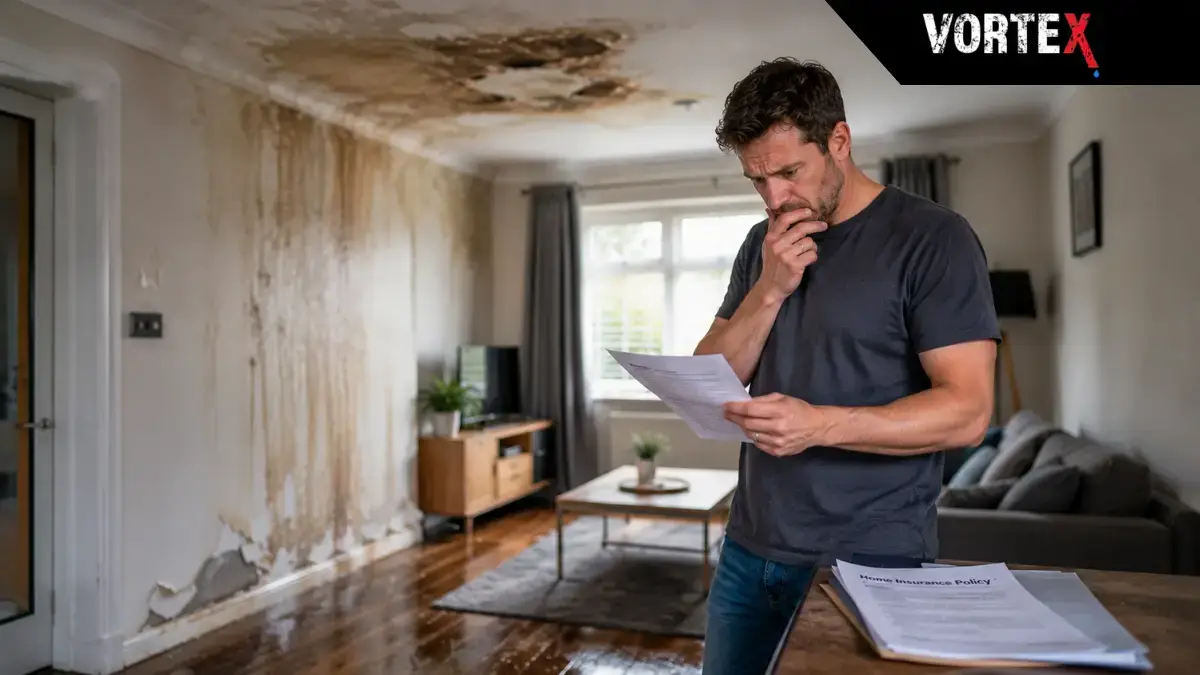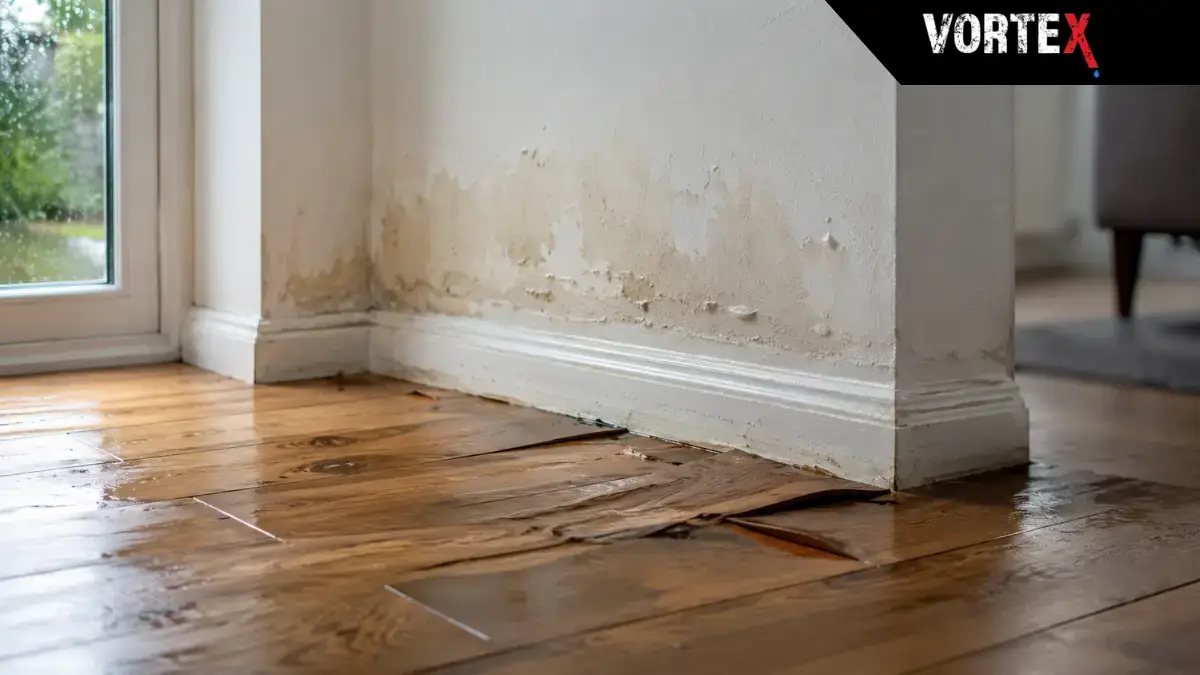

Yes. A hidden water leak that is not found and fixed causes progressive structural damage to the surrounding building fabric. The damage is not immediate in most cases, but it is cumulative, and it compounds continuously for as long as the leak continues. Understanding what actually happens, and how quickly it can escalate, is one of the most important reasons for treating a suspected hidden leak as something that needs investigation rather than monitoring.
The difficulty with structural damage from hidden leaks is that by the time it becomes visibly obvious, the underlying problem has usually been present for some time. The visible stain on a ceiling, the lifted floor covering, the crumbling plaster at skirting level: these are evidence of sustained moisture exposure that has already been happening, not warning signs that something might start to happen.
This article explains what structural damage a hidden water leak can cause, how quickly it develops, which materials are most vulnerable, and what the signs are that structural damage has already begun alongside a leak.
Quick Answer
Yes. Hidden water leaks cause structural damage through sustained moisture saturation of building materials. Concrete screed softens, timber swells and degrades, insulation fails, and mould establishes throughout affected areas. The damage compounds with every week the leak continues. A small slow leak running for months causes more cumulative damage than a large fast one that is found and fixed quickly.
The Short Answer: Yes, and the Damage Compounds Over Time
The mechanism of structural damage from a hidden water leak is straightforward. Water escaping from a pipe into the surrounding building material saturates it continuously. Different materials respond differently to sustained moisture: some degrade chemically, some fail mechanically, some support biological growth. All of them are changed in ways that affect their structural integrity, their thermal performance, or their habitability when they absorb sustained water.
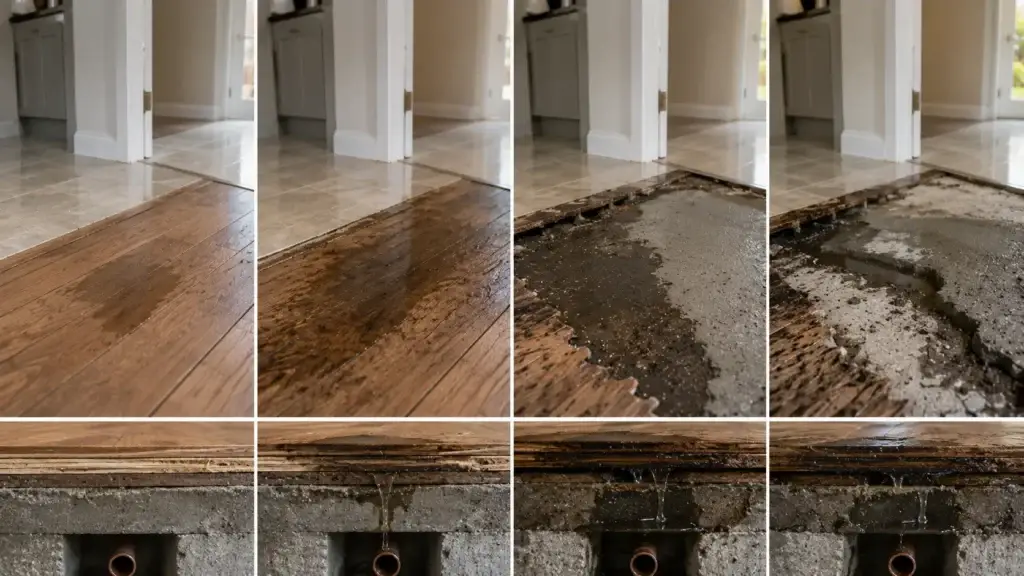
The key phrase is sustained. A brief moisture event, a single wetting and drying cycle, rarely causes significant structural harm. It is the continuous, uninterrupted moisture input of a slow hidden leak running for weeks and months that causes the damage. The longer the leak continues, the larger the saturated zone becomes, the deeper the moisture penetrates into structural elements, and the more extensive the remediation required after the leak is eventually found and fixed.
What Types of Structural Damage Does a Hidden Leak Actually Cause?
The structural damage from a hidden leak falls into several distinct categories, each affecting different parts of the building in different ways.
Screed degradation is among the most common consequences of underfloor pipe leaks. Concrete floor screeds are engineered to be rigid and load-bearing. Prolonged water saturation weakens the screed’s internal structure, causing it to soften, crack, and in severe cases begin to crumble. A screed that has been wet for months may no longer provide the structural base for a floor covering and may need partial or full replacement.
Timber damage is one of the most serious consequences of sustained moisture exposure. Timber structural elements, including floor joists, noggins, timber plate at the base of walls, and any structural timber in contact with the saturated zone, first swell and deform, then begin to degrade biologically. Wet rot, a fungal decay process, requires sustained moisture to establish and can progress to compromise the structural capacity of the affected timber over a period of months to years.
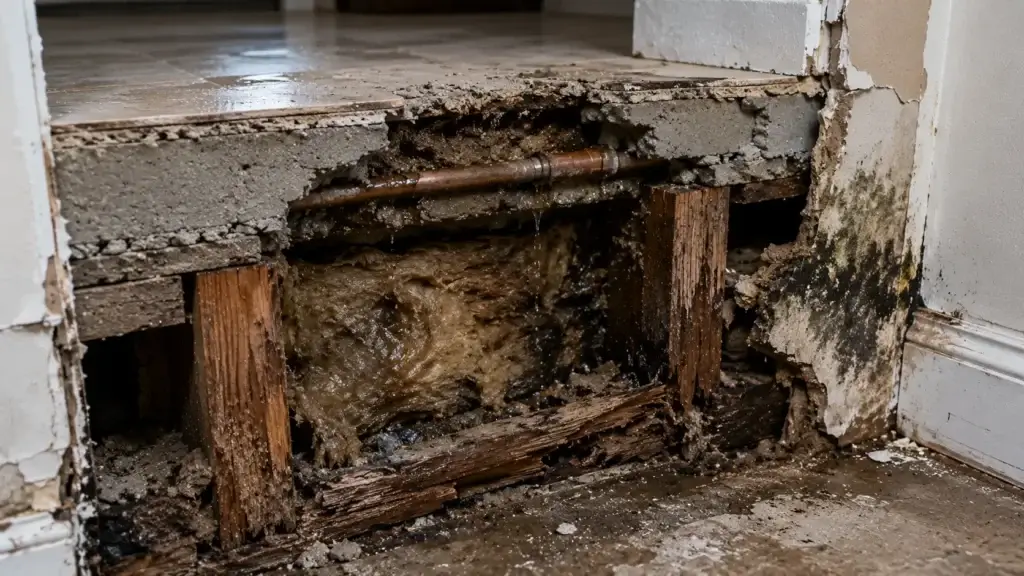
Insulation failure is less visible but significant. Floor insulation beneath a screed, cavity wall insulation, and pipe lagging all become permanently waterlogged once saturated. Waterlogged insulation does not dry out naturally in most building configurations. It retains moisture, loses its thermal effectiveness, and can become a substrate for mould growth within the enclosed space.
Plasterboard and internal wall linings absorb moisture readily. Plasterboard that has been wet for a prolonged period loses structural integrity, develops surface mould, and may begin to physically disintegrate. This affects both partition walls and the linings of external wall construction.
Mould growth is both a structural and a habitability consequence. Mould establishes itself in any material that provides sustained moisture above a threshold level. Once established, it spreads through the surrounding material, produces spores, and can penetrate deeply into porous substrates. Remediating extensive mould often requires removal of the affected material rather than surface treatment alone.
Which Building Materials Are Most Vulnerable?
| Material | Vulnerability to Hidden Leaks | Primary Risk | Typical Onset of Damage |
| Concrete screed | High | Softening, cracking, and load-bearing failure | Several months of saturation |
| Timber joists and structural timber | Very high | Wet rot, swelling, structural compromise | Two to six months of contact moisture |
| Floor insulation | High | Permanent waterlogging, mould substrate | Weeks to months |
| Plasterboard | High | Structural failure, mould growth, disintegration | Weeks of saturation |
| Render and plaster | Medium | Blowing, cracking, efflorescence, staining | Months of moisture exposure |
| Brick and blockwork | Low to medium | Efflorescence, freeze-thaw damage, mortar weakening | Extended periods only |
| Floor adhesives and screeds | High | Bond failure, lifting, substrate delamination | Weeks to months |
| Metal fixings and ties | Medium | Corrosion, structural fixing failure over time | Extended periods of wet conditions |
How Quickly Does Structural Damage Develop?
The rate at which structural damage develops depends on three primary factors: the volume of water being released, the material composition of the surrounding structure, and the environmental conditions in the affected space.
A faster leak releases more water per day, saturates the surrounding material more rapidly, and causes structural degradation on a shorter timescale. A slow pinhole leak releases less water per day, but its insidious nature means it often goes undetected for far longer, ultimately delivering a comparable or greater total volume of water into the structure.
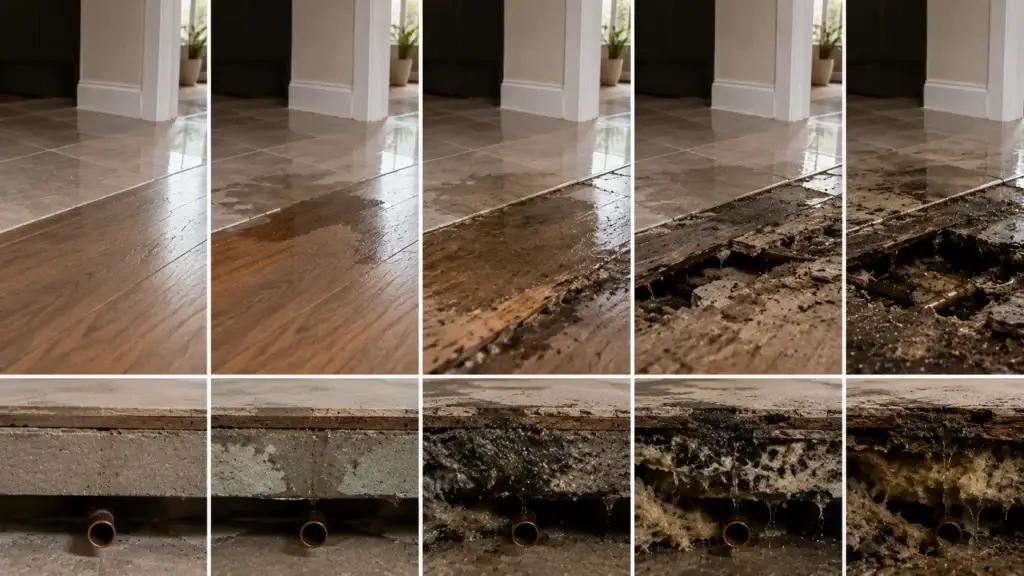
The material involved matters significantly. Timber reaches critical moisture levels and begins to support fungal decay at sustained moisture content above a threshold that a slow hidden leak can deliver over weeks. Concrete screed changes more slowly but is harder and more expensive to remediate once significantly damaged. Plasterboard fails relatively quickly under sustained wet conditions compared to masonry.
The Timeline of Damage: Weeks, Months, and Years
| Time Since Leak Began | Material Impact | Visible Signs Likely? | Structural Assessment Needed? |
| One to four weeks | Moisture absorbed by immediately surrounding material. Earliest saturation of screed or insulation. | Unlikely unless surface covering is very thin | No, but investigation warranted |
| One to three months | Screed begins to soften. Timber in contact starts to swell. Insulation waterlogged. Early mould establishing in enclosed spaces. | Possibly: soft floor patch, faint smell, slight wall discolouration | Recommended alongside leak detection |
| Three to six months | Wet rot establishing in timber. Screed losing structural integrity. Plasterboard softening. Mould spreading. | Probable: floor lifting, visible staining, musty smell, soft skirting boards | Recommended, specialist drying survey needed after repair |
| Six months to one year | Significant timber degradation. Screed failure in affected zone. Extensive mould. Metal fixings corroding. Insulation permanently failed. | Yes: visible structural signs, significant floor or wall damage | Structural survey likely needed alongside full drying programme |
| Over one year | Potential load-bearing timber compromise. Extensive screed replacement needed. Mould remediation required. Full floor replacement typical. | Yes: major visible damage | Structural survey essential before repair work begins |
Signs That Structural Damage Has Already Begun
Structural damage from a hidden leak may already be present if:
- Flooring feels soft, spongy, or springy underfoot in a localised area
- Floor coverings are lifting, bubbling, or separating at joints in a defined zone
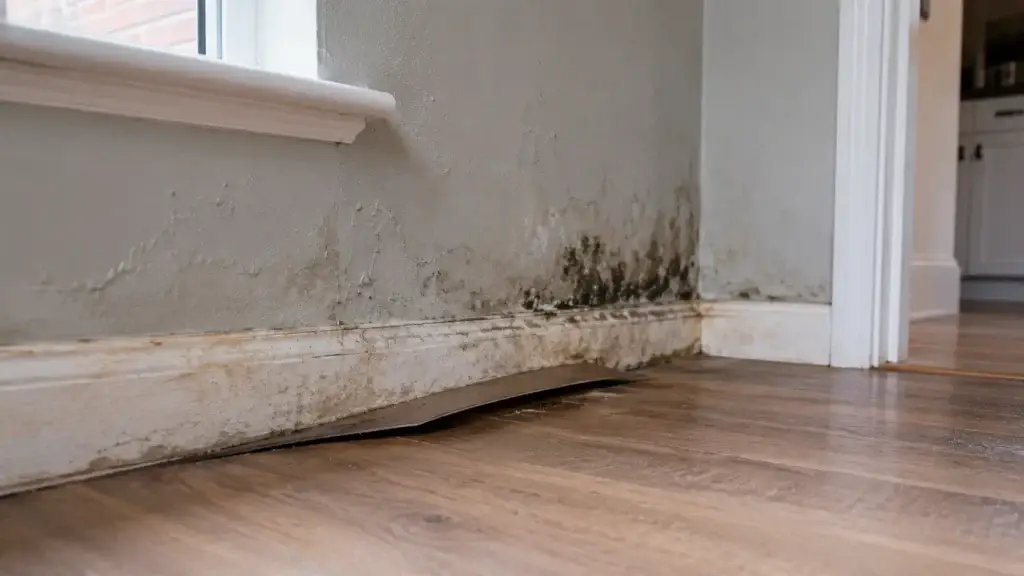
- Skirting boards feel soft when pressed or show signs of shrinkage, splitting, or discolouration at the base
- Plasterwork on lower sections of walls is blowing, cracking, or showing tide marks
- A persistent musty smell is present at floor level in a room without an obvious surface moisture source
- Mould is appearing at low level on walls, on the underside of floor coverings, or at the base of fitted units
- The floor in a affected area has developed an uneven surface or a visible sag
- Metal fixtures such as pipe clips or floor screws show signs of rust in an area that should be dry
The Difference Between Surface Damage and Structural Damage
Surface damage from a hidden leak is damage to decorative and finishing materials: staining on walls, marks on flooring, discolouration of plasterwork. These are repairable and relatively low cost once the leak is fixed and the affected area has dried.
Structural damage affects load-bearing or integrity-critical elements: the floor screed, the timber joists, the structural plaster substrate, the wall ties in a cavity wall. Remediation of structural damage is more involved, more disruptive, and more costly. In severe cases it requires building work beyond straightforward drying and redecoration.
The distinction matters practically because the remediation plan after a leak is found and fixed needs to assess both layers. A specialist drying survey can identify the extent of moisture penetration and indicate whether structural damage has reached the point where assessment by a structural engineer or building surveyor is appropriate before reinstatement begins.
Does a Leak Have to Be Large to Cause Serious Damage?
No. This is one of the most important and counterintuitive facts about hidden leak damage. A small, slow pinhole leak is in many respects more damaging than a large, fast one, for a single reason: the large fast leak announces itself quickly through surface signs and is found and fixed. The small slow leak may produce no visible surface sign for months. In the meantime, it continues to release water into the surrounding structure at a rate that is modest per day but cumulative and significant over weeks and months.
A pinhole leak in a buried heating pipe that has been running undetected for six months may have released a considerable total volume of water into the surrounding screed and insulation before the pressure drop on the boiler gauge prompted investigation. The structural impact of that volume, delivered slowly into an enclosed space with no opportunity to dry out, is often more severe than the impact of a larger leak that is found within weeks.
What Happens to Timber in a Sustained Hidden Leak Scenario?
Timber is one of the most vulnerable structural materials to hidden leak damage and one of the most serious concerns in any sustained moisture scenario. The process of timber deterioration in a sustained wet environment follows a predictable sequence.
Initially, timber absorbs moisture and begins to swell. This swelling can cause physical distortion, affecting door frames, structural connections, and the geometry of floor void construction. At this stage the timber has not been biologically compromised and may recover if dried promptly.
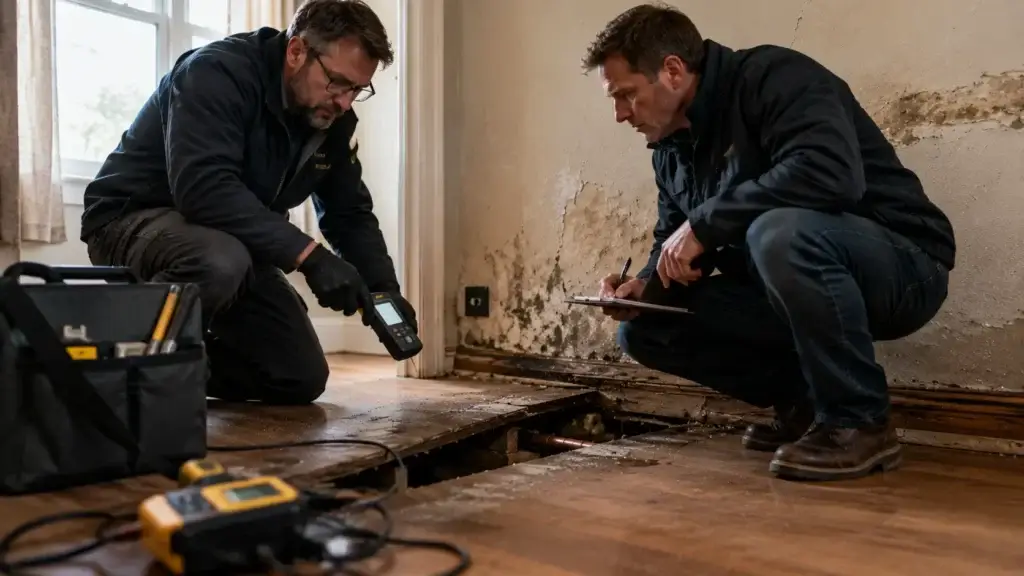
As moisture content remains elevated, the conditions become favourable for wood-decay fungi. Wet rot is the most common form of timber decay in persistently damp conditions in UK properties. Wet rot fungi digest the cellulose component of the timber, progressively reducing its structural strength. Affected timber feels soft when probed, may discolour to a dark brown or appear bleached depending on the fungal species, and in advanced cases crumbles when handled.
Dry rot, though less common in consistently wet conditions, can establish itself in an enclosed space where moisture fluctuates. Dry rot is significantly more aggressive than wet rot and can spread through masonry to affect timber remote from the original leak site. If structural timber shows signs of dry rot during remediation, specialist treatment and assessment is required.
Can a Hidden Leak Affect the Foundations of a Property?
In most domestic properties with standard concrete or masonry foundations, a hidden leak in the heating or plumbing circuit is unlikely to directly threaten the foundations. The volume of water and the timescales involved are typically insufficient to cause foundation movement in well-built modern properties.
There are exceptions. A mains supply pipe leak that releases water continuously into the ground immediately adjacent to a foundation, over a prolonged period, can in clay soil conditions contribute to localised shrinkage or swelling depending on the direction of soil moisture change. Properties on shrinkable clay soils with foundation or subsidence histories should be assessed by a structural engineer if a mains leak of any significant duration is confirmed near the building line.
In older properties with shallower or less robust foundations, and in properties where the ground beneath the floor has been saturated for a prolonged period, a structural assessment alongside the leak detection and repair is a sensible precaution rather than an unnecessary additional cost.
When Is a Structural Assessment Needed Alongside Leak Detection?
A structural assessment is advisable alongside or immediately after leak detection and repair in any of the following situations:
- The leak has been present for six months or more before detection
- Visible floor distortion, sagging, or uneven surfaces are present in the affected zone
- Timber structural elements show visible signs of decay, softness, or discolouration
- The property has a known subsidence history and the leak is near the foundation line
- The affected area involves load-bearing walls, structural floor construction, or a beam and block ground floor
- Mould is extensive and appears to have penetrated the building fabric rather than being confined to the surface
The specialist drying survey that follows leak repair can identify moisture levels and the depth of penetration, which guides whether a structural assessment is appropriate. A building surveyor or structural engineer can then assess the specific elements of concern and advise on the remediation sequence.
What to Do If You Suspect Structural Damage Is Already Present
If you have found a hidden leak and are concerned that structural damage has already occurred, the response plan has several stages. Fix the leak first. No remediation is meaningful while the source of moisture is still active. Once the leak is repaired, arrange a specialist drying survey to map the extent of moisture in the surrounding material and establish a drying programme.
Do not reinstate floors, walls, or decorative finishes before the underlying material has been confirmed as sufficiently dry. Premature reinstatement traps residual moisture and can restart the degradation process even after the pipe is repaired. The drying programme may take weeks to months depending on the severity of the saturation.
If any of the structural warning signs described in this article are present, commission a structural assessment before significant repair work begins. The assessment determines the correct remediation sequence and identifies whether any structural elements need replacement rather than simple drying and reinstatement.
What to Do Next
If you have a suspected or confirmed hidden leak, the most important step is to arrange a specialist detection survey as early as possible. The earlier the leak is found and fixed, the less structural damage it has caused and the simpler and less costly the remediation that follows.
The Vortex Leak Detection team locates hidden leaks using thermal imaging, acoustic detection, and tracer gas without requiring exploratory damage to floors or walls. Get in touch at vortexleakdetection.co.uk/contact-us-vortex/ to arrange an investigation.
Every week counts.
- A hidden leak that is undetected for months causes damage that costs
- significantly more to remediate than the same leak found quickly.
- Early specialist detection is the most cost-effective structural
- protection available to a homeowner with a suspected leak.