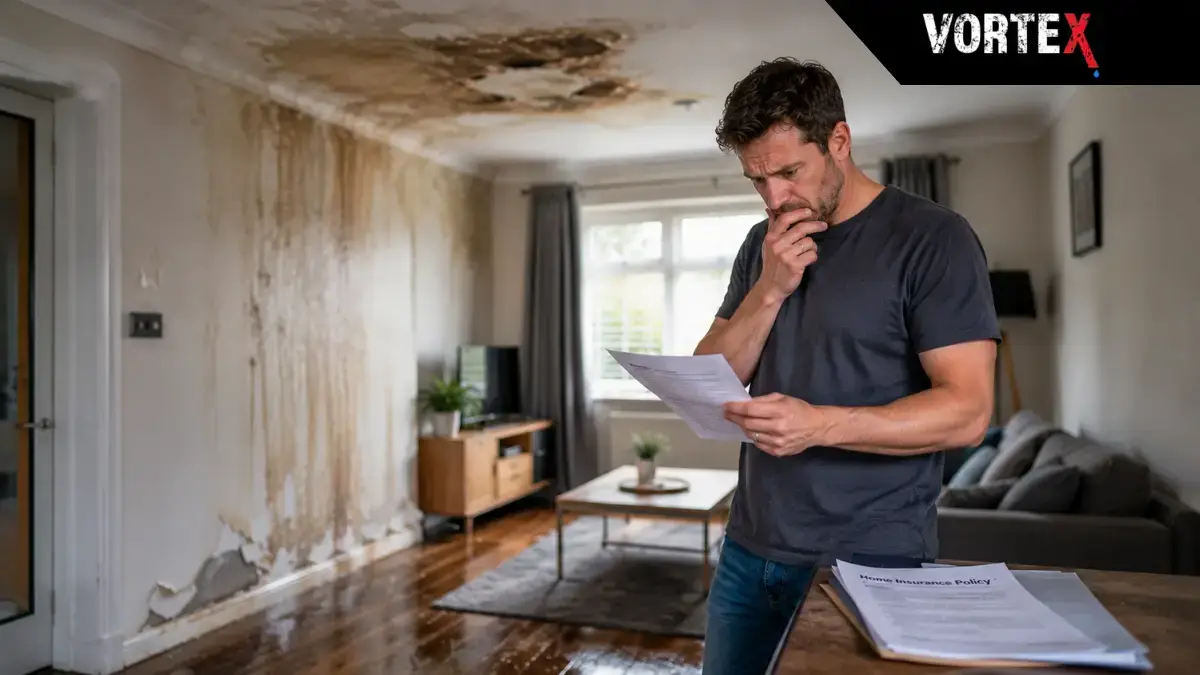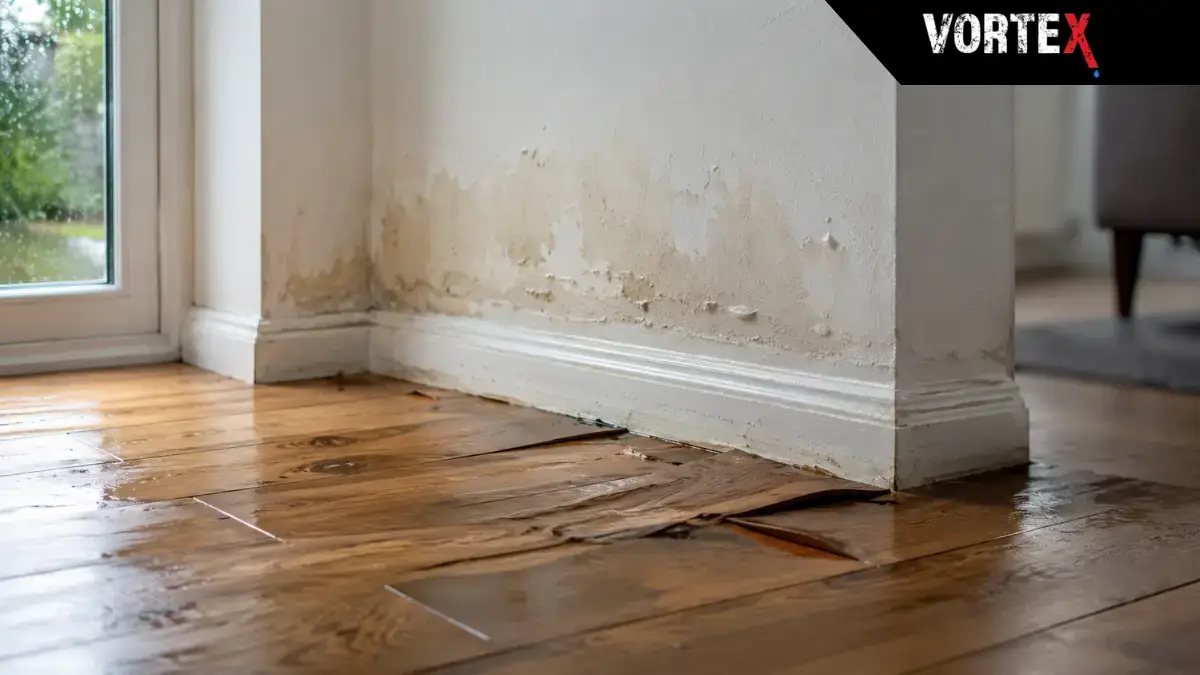

A water leak coming through the ceiling from the flat above is one of the most distressing property situations a flat owner or tenant faces. The damage can be immediate and visible: stained ceilings, damaged plasterwork, ruined flooring, and soaked possessions. But beyond the physical damage, the situation quickly becomes complicated by questions of responsibility, insurance, and neighbour relations that are not always straightforward to navigate.
Understanding who is responsible for a flat-to-flat water leak, what the process for resolving it typically involves, and what role a specialist leak detection report plays in moving the situation forward is essential for anyone dealing with this scenario. This article provides practical guidance on all of those questions, with the caveat that specific legal rights in leasehold disputes depend on the terms of individual leases and the applicable law, and that complex or unresolved disputes may require independent legal advice.
| Quick AnswerWhen water leaks from an upstairs flat into yours, the first step is to notify the upstairs leaseholder and the building’s freeholder or managing agent immediately. Responsibility typically depends on where the leak originates: leaks from within the upstairs flat are generally the upstairs leaseholder’s responsibility; leaks from shared pipes are generally the freeholder’s. A specialist leak detection report identifying the source is usually essential for insurance claims and dispute resolution. |
The First Thing to Do When Water Is Coming Through from Above
Before considering responsibility, rights, or insurance, the immediate priority is to limit the ongoing damage. Water continuing to enter your property causes progressive structural damage that compounds with every hour it continues. Acting quickly on the practical steps first gives you the best chance of limiting the total damage and the remediation cost.
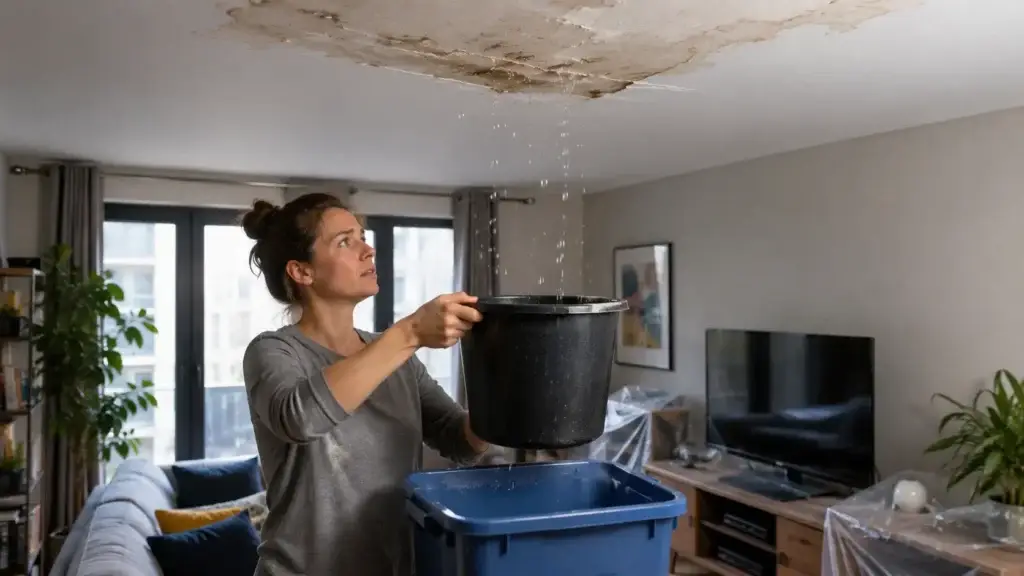
| Immediate steps when water enters from the flat above:Contact the upstairs neighbour immediately by knocking on their door, phoning them, or using the building entry system. If there is no response, contact the building’s freeholder or managing agent.If the upstairs flat is unoccupied and water is still actively flowing, contact the building’s freeholder or managing agent and request emergency access to turn off the supply. In an emergency where no one can be reached, a plumber may need to isolate the supply.Move valuable possessions, electronics, and furniture out of the area being affected. Water damage to contents may be covered by your own contents insurance.Document the damage thoroughly with photographs and video before any cleaning up is done. Record the date and time. This evidence is essential for any insurance claim.Place buckets or containers to collect dripping water if safe to do so. Do not stand in water near electrical fittings.Notify your own home insurance provider as soon as practical, even if you believe the upstairs neighbour should be responsible. Your insurer can advise on the claims process and may handle the initial response.Make written records of all communications with the upstairs neighbour, freeholder, managing agent, and insurers from the first day. |
Who Is Responsible for a Leak from an Upstairs Flat?
Responsibility for a flat-to-flat water leak is determined primarily by where the leak originates. In leasehold properties, which is the typical ownership structure for flats in the UK, the boundary between individual leaseholder responsibility and freeholder or building management responsibility is defined by the terms of the lease. General principles apply in most cases, but the specific wording of the lease is the definitive reference.
When the Leak Is from a Pipe Within the Upstairs Flat
If the leak originates from a pipe, appliance, or fitting that is within the upstairs leaseholder’s demise, meaning the area they own and are responsible for under the terms of their lease, then the upstairs leaseholder is generally responsible for the leak and for its consequences. This covers burst pipes within the flat, overflowing baths or showers, leaking appliances, and failed plumbing joints within the property.
In these circumstances the downstairs flat owner may have a claim against the upstairs leaseholder for the damage caused to their property. This claim can be pursued through the leaseholders’ own buildings insurance, through the upstairs neighbour’s buildings or liability insurance, or in some cases directly through legal channels if insurance does not cover the full extent of the damage.
When the Leak Is from a Shared or Common Area Pipe
If the leak originates from pipework that serves the building as a whole, rather than pipework within any individual flat, such as the rising main for the block, the shared drainage stack, or pipes within communal areas, the responsibility typically falls on the freeholder or management company rather than on any individual leaseholder.
In these cases the freeholder’s buildings insurance for the block is typically the relevant policy, and the freeholder has an obligation to repair the shared infrastructure and address the resulting damage.
When the Cause Is Not Yet Identified
This is the most common and most problematic situation. Water is entering the downstairs flat, but the exact source has not been confirmed. The upstairs neighbour cannot see or find a leak in their flat. No visible cause is apparent from above. In this scenario, responsibility cannot be properly assigned until the source is identified. This is precisely where a specialist leak detection survey becomes the most important intervention. Without knowing where the leak is coming from, both insurers and the parties involved are working from assumption rather than evidence.
What If the Upstairs Neighbour Disputes Responsibility?
Disputes about responsibility in flat-to-flat leaks are common, particularly when the source of the leak is not immediately obvious. An upstairs neighbour who cannot see any leak in their flat, and whose flooring or fittings appear dry, may genuinely believe the problem is not originating from their property. In some cases they may acknowledge a problem but dispute liability for the damage caused below.

A specialist leak detection report is the most powerful tool available for resolving these disputes. The report documents the source of the leak with precision, using detection methods that can identify a hidden pipe failure that the occupant above cannot see. If the report confirms the source is within the upstairs flat, the leaseholder’s liability becomes significantly harder to dispute. If the report identifies the source as a shared pipe, it clearly shifts responsibility to the freeholder or management company.
Without a specialist report, the dispute remains one party’s word against another’s. With a report, there is documented evidence of the source, the methods used to identify it, and the confirmed location. This is the evidence that insurers, managing agents, and if necessary courts rely on to resolve the dispute.
What Is the Role of the Freeholder or Managing Agent?
In a block of flats, the freeholder owns the structure of the building and the common areas. The managing agent acts on the freeholder’s behalf to maintain the building and manage leaseholder relations. Both have a role to play in a flat-to-flat leak dispute.
The freeholder or managing agent should be notified immediately when a leak is discovered, even if the source appears to be within an individual flat. They have authority that individual leaseholders do not: they can arrange access to the upstairs flat for investigation if the leaseholder is unresponsive, they can instruct emergency repairs to the building fabric, and they can engage the building’s insurance to cover the remediation of structural damage.
Many leases require leaseholders to notify the freeholder of any damage to or from their property. The freeholder’s response, whether prompt or delayed, becomes part of the record. If the freeholder fails to act appropriately in response to a leak that falls within their responsibility, the downstairs leaseholder may have a claim against the freeholder for that failure.
How Does Buildings Insurance Work in a Flat Leak Dispute?
Also Read: Escape of Water Insurance Claim: What You Need to Know Before You Start
The buildings insurance landscape for leasehold flats varies. In many blocks, the freeholder holds a single buildings insurance policy for the entire building, and individual leaseholders do not hold separate buildings insurance. In some blocks, leaseholders hold their own buildings insurance for their individual flat. The lease terms determine which arrangement applies.
When water damage occurs in a downstairs flat due to a leak from above, several insurance scenarios are possible. If the freeholder holds the block policy, the damage may be covered under that policy subject to any excess and exclusions. If the upstairs leaseholder has liability insurance or their own buildings policy, their insurer may accept the claim for the damage caused below. If the downstairs flat owner holds their own buildings policy, they can claim for the damage to their property under that policy, and their insurer may pursue a recovery claim against the upstairs leaseholder or freeholder.
In practice, the most efficient route is often for each party to notify their own insurer and allow the insurers to resolve the liability question between themselves. This avoids the downstairs leaseholder being left in a protracted dispute while their damaged property waits to be remediated. Where trace and access cover exists in the relevant policy, the cost of the specialist detection survey may be covered by the policy. For a full explanation of how trace and access cover works, the article on what trace and access means on a home insurance policy covers this in detail.
Why a Specialist Leak Detection Report Changes Everything
In a flat-to-flat leak dispute, the specialist detection report is not simply a useful piece of evidence. It is often the decisive piece of evidence. Without it, everyone involved is working from observation and assumption. With it, the source of the leak is documented with technical precision.
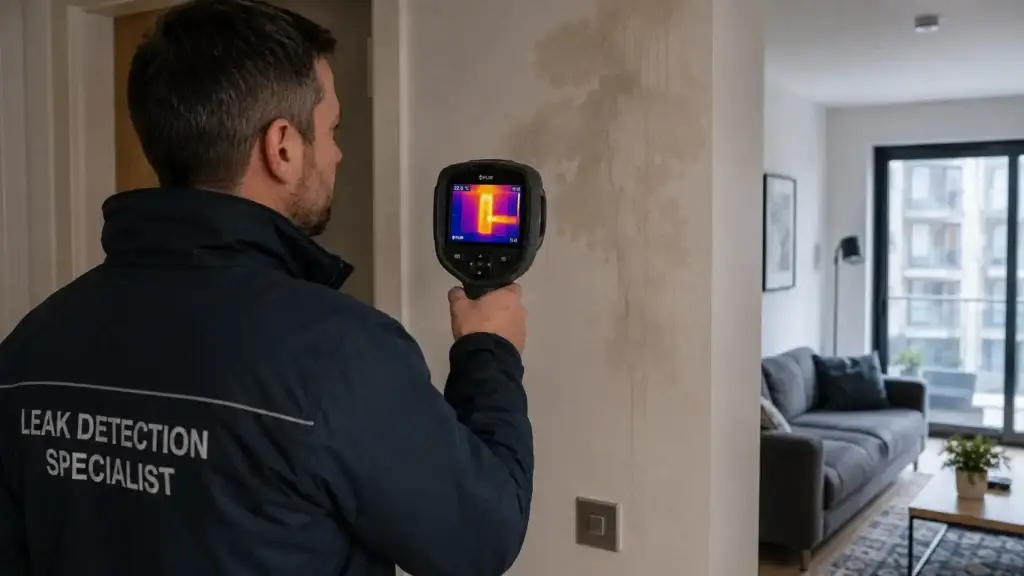
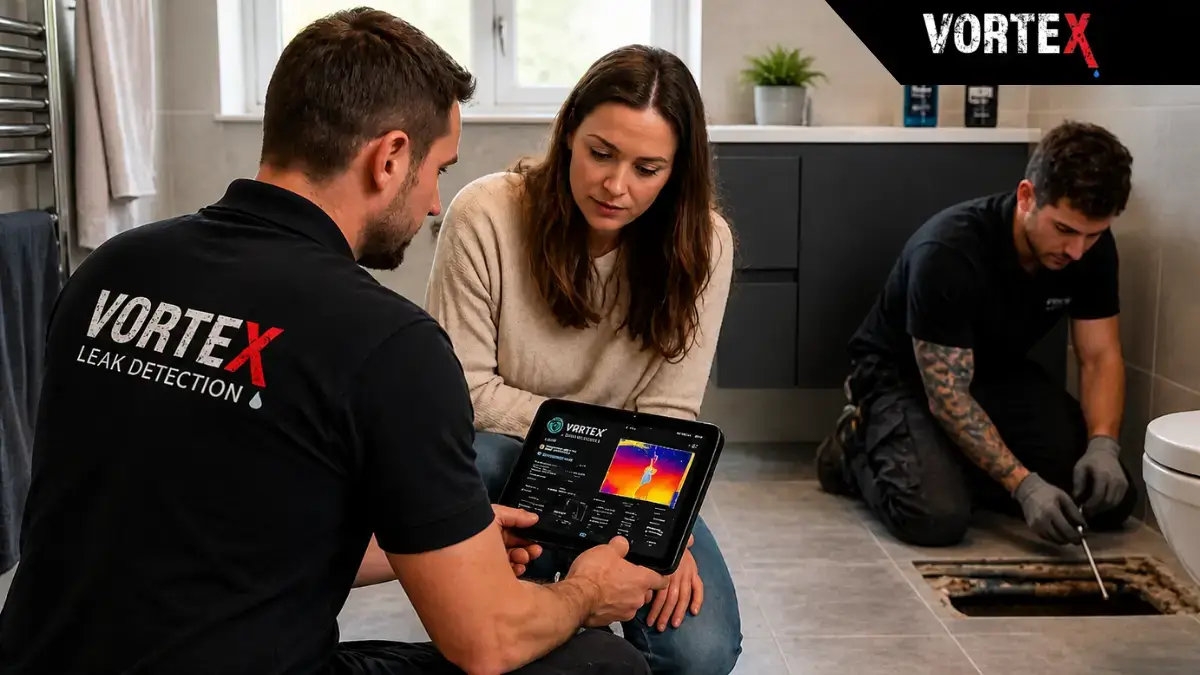
A specialist leak detection survey uses thermal imaging, acoustic detection, and tracer gas to locate the origin of a leak without requiring the upstairs flat to be destructively investigated. The specialist works from the downstairs flat and from any areas of the upstairs flat where access is permitted, using equipment that can identify a hidden pipe failure in a location that the occupant above has not been able to see or find.
The written report that follows documents everything: the methods used, the evidence gathered, the confirmed location of the leak source with reference measurements, and the recommendation for repair access. This report is what transforms a dispute based on observation into a resolution based on evidence. Insurers understand and accept specialist detection reports. Managing agents and freeholders understand them. Solicitors, if legal escalation becomes necessary, can rely on them.
There is a practical dimension to this as well. The report directs the repair precisely. The plumber who fixes the leak knows exactly where to access the pipe. The access is targeted rather than speculative. The disruption to both flats involved is minimised because the location is confirmed before any floor or wall is opened.
What Does a Specialist Report Include and Why Do Insurers Require It?
A specialist leak detection report produced for a flat-to-flat situation typically includes the date and property addresses involved, a description of the presenting symptoms and the areas investigated, the detection methods used, the evidence produced by each method, the confirmed source of the leak with reference measurements from identifiable fixed points, photographs and thermal images supporting the findings, and a recommendation for repair access.
Insurers require this level of documentation because it establishes the cause and origin of the damage beyond reasonable doubt. An insurer processing a water damage claim needs to know whether the damage resulted from a defined insured event and what the source was. A specialist report provides that confirmation. Without it, the insurer may not be able to approve the claim or may require an independent investigation before doing so, adding time and cost to the process.
Can You Force Your Neighbour to Fix the Leak?
This is a question that touches on leasehold law and the specific terms of the lease, and the answer varies depending on those terms and the circumstances. Generally speaking, leaseholders in England and Wales have obligations under their leases to maintain and repair the parts of the property for which they are responsible, and a failure to do so that causes damage to another leaseholder can give rise to legal liability.
Practically, the most effective routes before legal escalation are notification in writing to the upstairs leaseholder, notification and formal request for action to the freeholder or managing agent, and engagement of your own insurer. Most disputes are resolved through these channels once the source of the leak has been identified and documented, because the evidence makes further denial or delay difficult to sustain.
If the upstairs leaseholder refuses to act despite a documented specialist report confirming the source is within their property, the route escalates to the freeholder if the lease allows, to mediation, or ultimately to legal action. This is where independent legal advice becomes appropriate, as the specific lease terms and the applicable law determine what options are available.
What If the Leak Has Already Caused Damage to Your Property?
If the leak has caused damage to your ceiling, walls, floor, or contents before it was stopped, documenting that damage thoroughly is essential. Photographs, video, and a written description of the damage with dates create the evidence record that any insurance claim or legal claim requires.
The distinction between buildings damage and contents damage matters for insurance purposes. Buildings damage, including damage to the plasterwork, ceiling structure, floor covering, and fitted units, is covered by buildings insurance. Contents damage, including furniture, electronics, and personal possessions, is covered by contents insurance. Both should be notified to the relevant insurers as soon as practical.
Structural damage that has resulted from the leak, including waterlogged timber, failed plasterwork, or damage to the floor structure, may require specialist assessment before remediation begins. A specialist drying survey after the leak is fixed confirms the extent of moisture penetration and guides the drying programme before reinstatement is attempted.
What About Flats in a Block Where Responsibility Is Unclear?
In some buildings, particularly older converted properties or buildings managed informally, the division of responsibility is genuinely unclear. The lease may be imprecise, the freeholder may be absent or unresponsive, or the building may not have a clear management structure.
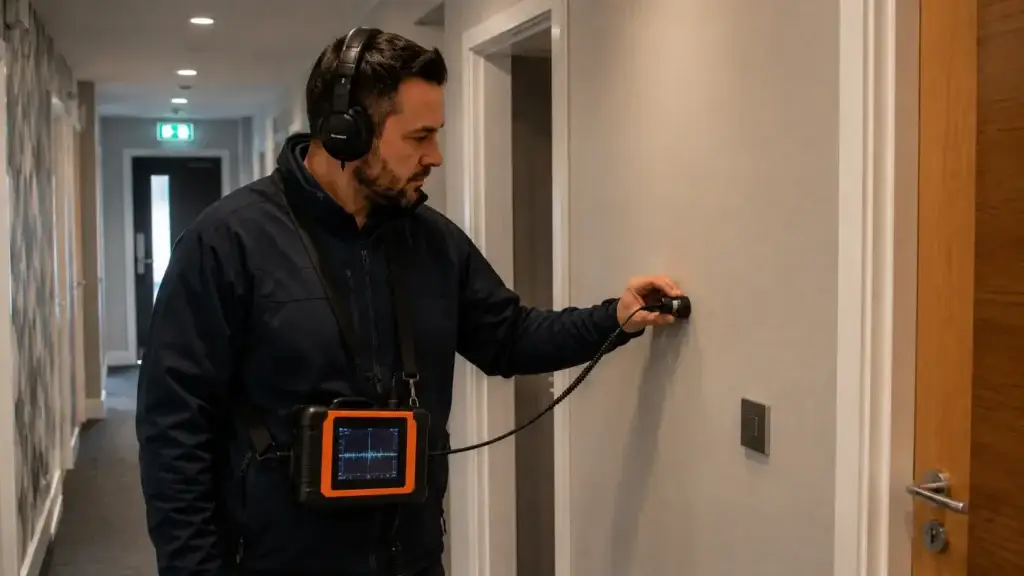
In these situations the specialist leak detection report is even more important because it provides the objective evidence that allows responsibility to be established regardless of who is initially willing to accept it. If the report confirms the source, it creates a factual record that is independent of the parties involved and that any subsequent formal process, whether insurance, mediation, or legal, can rely on.
The Process From Discovery to Resolution: A Practical Timeline
| Stage | Who Is Involved | What Happens | Typical Timeframe |
| Discovery and containment | Both leaseholders, freeholder or managing agent | Notify upstairs neighbour and managing agent. Document damage. Move possessions. Arrange for water to be turned off if still running. | Within hours of discovery |
| Notify insurers | Both leaseholders, freeholder | Each party notifies their relevant insurer. Claim references obtained. | Within 24 to 48 hours |
| Specialist leak detection survey | Specialist, both leaseholders if access needed | Survey identifies and confirms the source of the leak. Written report produced. | Arranged within days, report within 1 to 3 working days after survey |
| Responsibility established | Insurers, freeholder or managing agent, leaseholders | Report is submitted. Responsibility assigned based on confirmed source. | Within days to weeks of report submission |
| Leak repaired | Qualified plumber, relevant responsible party | Repair made at confirmed location. Minimal access required. | Days after responsibility is confirmed |
| Drying programme | Specialist drying contractor | Affected materials dried to acceptable moisture levels. | Weeks to months depending on severity |
| Reinstatement | Building or decorating contractor | Ceiling, walls, and finishes reinstated. | After drying confirmed as complete |
| Settlement of damage claim | Insurers, leaseholders | Insurance claims processed and settled. | Variable, typically weeks to months |
What to Do Next
If you have water coming into your flat from above and need documented evidence of the source for an insurance claim, a dispute resolution, or a conversation with your managing agent, a specialist leak detection survey provides that evidence with precision.
Vortex Leak Detection carries out surveys and produces comprehensive written reports for flat-to-flat leak situations. Our reports document the methods used, the evidence found, and the confirmed source, providing the documentation that insurers, managing agents, and leaseholders need to move the situation forward. Get in touch to discuss your situation and arrange an assessment.
| A specialist report turns a disputed leak into a documented fact.If responsibility for a flat-to-flat leak is being disputed, a specialistdetection report identifying the source with precision is the mosteffective way to move the situation forward.vortexleakdetection.co.uk/contact-us-vortex/ |