
Most domestic leak detection surveys take between two and four hours from the specialist’s arrival to the point where the findings are explained and the visit concludes. The exact duration depends on the size of the property, the complexity of the pipe layout, the number of areas that need investigating, and which detection methods are required for the specific situation.
For a homeowner or landlord who has not had a leak detection survey before, understanding what happens during those two to four hours, what the specialist needs access to, and what you receive at the end removes the uncertainty that can delay a booking. This article covers all of that, including what affects the duration in different scenarios.
Quick Answer
A typical domestic leak detection survey takes between two and four hours. Simpler scenarios, such as a single suspect area in a smaller property, can be completed closer to two hours. More complex investigations involving multiple suspect zones or larger properties may take four to six hours. Most surveys are completed within a single half-day visit.
The Short Answer: Two to Four Hours for Most Domestic Properties
Two to four hours is the realistic range for the majority of domestic hidden leak detection surveys. This covers the time from arrival to the point where the specialist explains the findings and leaves. It includes initial discussion, systematic investigation using detection equipment, documentation of findings, and a verbal summary.
The time estimate does not include travel, report writing, or any follow-up work. The written report is typically provided after the visit, usually within one to three working days. Any repair or access work is arranged separately and is not part of the survey visit.
What Happens During a Leak Detection Survey?
Understanding the sequence of a survey explains where the time goes and why the duration varies.
Initial Discussion (10 to 20 minutes)
The specialist begins by discussing the situation with the homeowner: what symptoms have been noticed, how long they have been present, the age and history of the heating and plumbing systems, any recent work done on the property, and where the pipe routes are believed to run. This context shapes the survey approach and helps the specialist prioritise where to begin.
Systematic Investigation (1.5 to 3 hours)
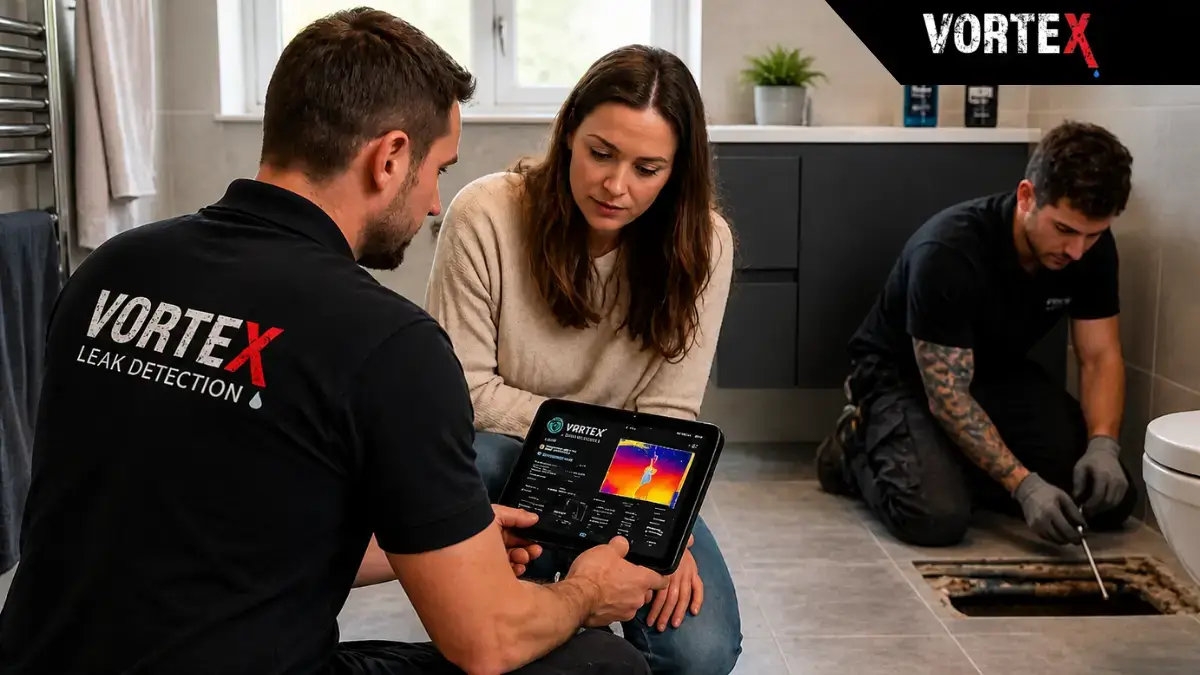
The core of the survey is the systematic application of detection equipment across the property. The specialist works through the building in a logical sequence, typically beginning with thermal imaging of the areas most likely to be affected based on the initial discussion, following up with acoustic detection in suspect zones, taking moisture meter readings at multiple points, and using tracer gas to confirm the position of any suspected leak.
The time taken for this phase depends on the number of areas to be investigated and the clarity of the signals found. When thermal imaging quickly produces a strong result in a defined area and tracer gas confirms it, the investigation can proceed rapidly. When signals are ambiguous or multiple areas need investigation before a conclusion can be reached, the process takes longer.
Verbal Summary (10 to 20 minutes)
At the end of the investigation the specialist explains the findings clearly: what has been found, where the leak is located, what the detection evidence shows, and what the recommended next step is. This is also the opportunity for the homeowner to ask questions.
What Factors Affect How Long the Survey Takes?
Property Size
A larger property has more floor area to survey, more pipe routes to investigate, and more potential areas of concern. A two-bedroom flat takes less time than a five-bedroom detached house. The relationship is not strictly proportional because the survey focuses on the suspect areas rather than covering every square metre of the property, but larger properties generally require more time.
Number of Suspect Areas
A survey focused on a single clearly defined suspect area, a specific section of underfloor heating where the boiler pressure loss is pointing, takes less time than a survey where multiple areas are showing signs and each needs systematic investigation before the source can be confirmed.
Complexity of the Pipe Layout
Properties with complex pipe layouts, multiple circuits, or unusual routing, often associated with older properties that have had plumbing added at various points, take longer to survey because the specialist needs to build a picture of the system before focusing the detection work on the most probable areas.
Clarity of Detection Signals
When the thermal image is clear, the acoustic signal is strong, and tracer gas confirms a specific location quickly, the investigation moves efficiently. When conditions are less favourable, for example a very slow leak in a deep pipe in cold weather, the signals are weaker and the investigation takes more time to reach a confident conclusion.
Access Conditions
The speed with which the specialist can move through the property and access the areas to be investigated affects duration. Properties where furniture needs to be moved, where floor areas are obstructed, or where access to specific rooms is limited will take longer than fully accessible properties.
Read Further: What Is a Home Plumbing Survey And Do You Need One?
Typical Survey Durations by Scenario
| Scenario | Typical Duration | Notes |
| Single suspect area in a small flat or terraced house | 1.5 to 2.5 hours | Focused investigation, clear pipe routes |
| Single suspect area in a larger detached property | 2 to 3 hours | More floor area to cover to rule out other zones |
| Multiple suspect areas in a medium property | 3 to 4 hours | Each zone requires systematic investigation |
| Underfloor heating system in a large property | 3 to 5 hours | Full circuit coverage needed; thermal imaging takes more time |
| Mains supply pipe investigation in grounds and sub-floor | 2 to 3 hours | External ground and entry point focus; acoustic led |
| Complex property with multiple circuits and uncertain pipe routes | 4 to 6 hours | System mapping needed before focused detection can begin |
| Full home plumbing survey (all systems assessed) | 3 to 5 hours | Broader scope than a targeted leak detection survey |
Do You Need to Be Present During the Survey?
Yes, or a responsible adult who knows the property should be present. The initial discussion at the start of the survey is important, as the specialist needs information about the symptoms, the system history, and the pipe layout that only the occupant or owner can provide. The verbal summary at the end of the visit also requires someone to receive and understand the findings.
For rental properties, the landlord or a letting agent representative should be present. A tenant alone may not have sufficient knowledge of the system history to support a productive initial discussion, and the findings discussion benefits from someone with decision-making authority being present.
What Access Does the Specialist Need?
The specialist needs access to the areas of the property where the suspect pipes run and where the detection equipment will be used. In most domestic surveys this means access to all ground floor rooms where the heating circuit or supply pipes run beneath the floor, access to the boiler and the heating system controls, access to the water meter and internal stopcock, and access to any outdoor areas where a supply pipe or drain run is suspected.
Furniture does not generally need to be moved for thermal imaging or acoustic detection, as these methods work through floor coverings and surfaces. However, if a specific area needs closer investigation and it is obscured by heavy furniture, moving it will help. The specialist will advise on this at the time.
What to Prepare Before the Survey
To make the most of the survey visit, prepare the following beforehand:
- Note down all the symptoms you have noticed: when they first appeared, whether they are getting worse, and where in the property they are most pronounced
- Note the current boiler pressure reading and when the boiler was last repressuised
- Have the boiler manual or system documentation available if possible
- Ensure access to all areas of the property where pipes are suspected to run
- If the water meter is outside, locate it before the specialist arrives
- Note any recent plumbing or building work carried out on the property
- If you have a home insurance policy with trace and access cover, have the policy details to hand
- Clear any areas of floor that are heavily obstructed and where you suspect the leak may be
What Do You Receive at the End of the Visit?
At the end of the survey visit, the specialist provides a clear verbal explanation of what has been found: the suspected or confirmed leak location, the evidence that supports that conclusion, and the recommended next step, whether that is a targeted repair, a further investigation of a second area, or monitoring.
The written report typically follows within one to three working days. The report documents the detection methods used, the evidence gathered, the confirmed or suspected leak location with reference measurements, and the recommendations. If the survey is supporting an insurance trace and access claim, the report includes the detail the insurer requires.
What Happens After the Survey?
If the survey confirms a leak location, the next step is arranging a repair by a qualified plumber who will access the pipe at the confirmed location and carry out the repair. The specialist’s report provides the plumber with the precise information needed for a targeted access. The repair, the drying period, and the reinstatement of the affected surface are all subsequent steps covered in the article on what happens after leak detection.
If the survey does not produce a definitive result because the signals are ambiguous or the conditions were unfavourable, the specialist will advise on the options: a second survey under different conditions, a targeted exploratory access at the most probable location, or a period of monitoring before a decision is made.
Quick Reference: Survey Duration at a Glance
Summary of what affects survey duration:
- Property size: larger properties take longer to survey systematically
- Number of suspect areas: each area requires full investigation
- Pipe layout complexity: unusual or multi-phase routing takes more time to map
- Detection signal clarity: clearer signals allow faster confirmation
- Access conditions: obstructed areas add time to the investigation
- Survey type: a full home plumbing survey takes longer than a targeted leak detection visit
What to Do Next
If you have a suspected hidden leak and want to arrange a specialist survey, get in touch with the Vortex Leak Detection team to discuss your situation, understand what the survey will involve for your specific property, and arrange a booking.
Continue Reading: Can a Hidden Water Leak Cause Structural Damage to Your Home?