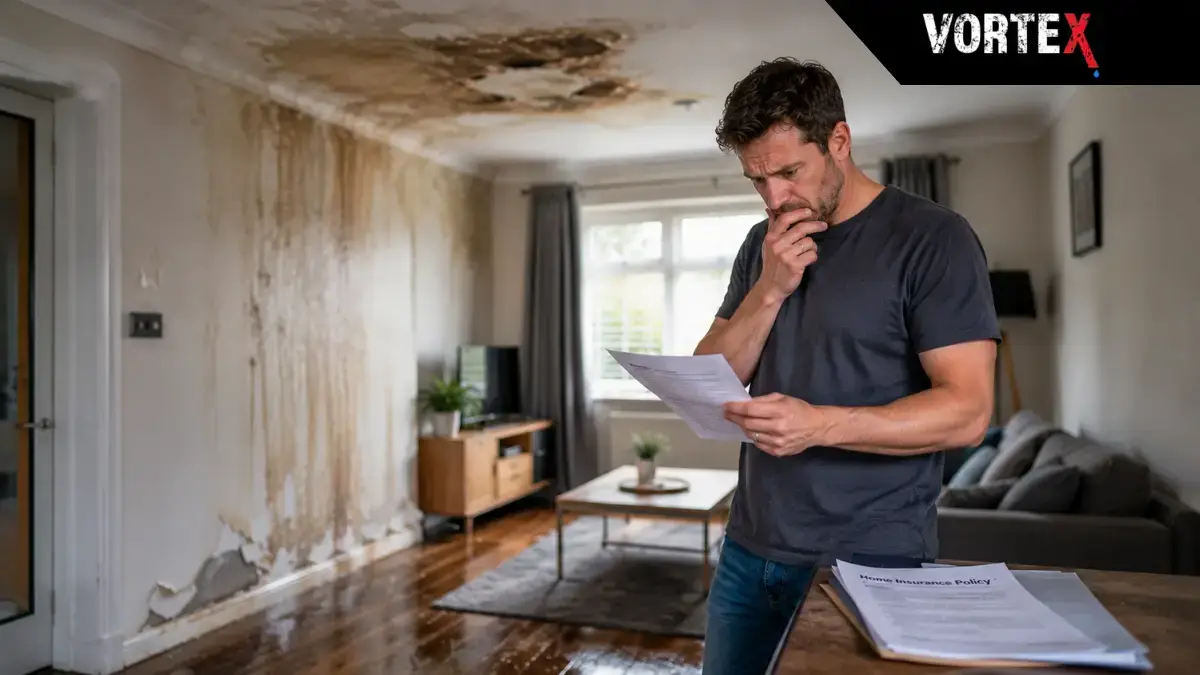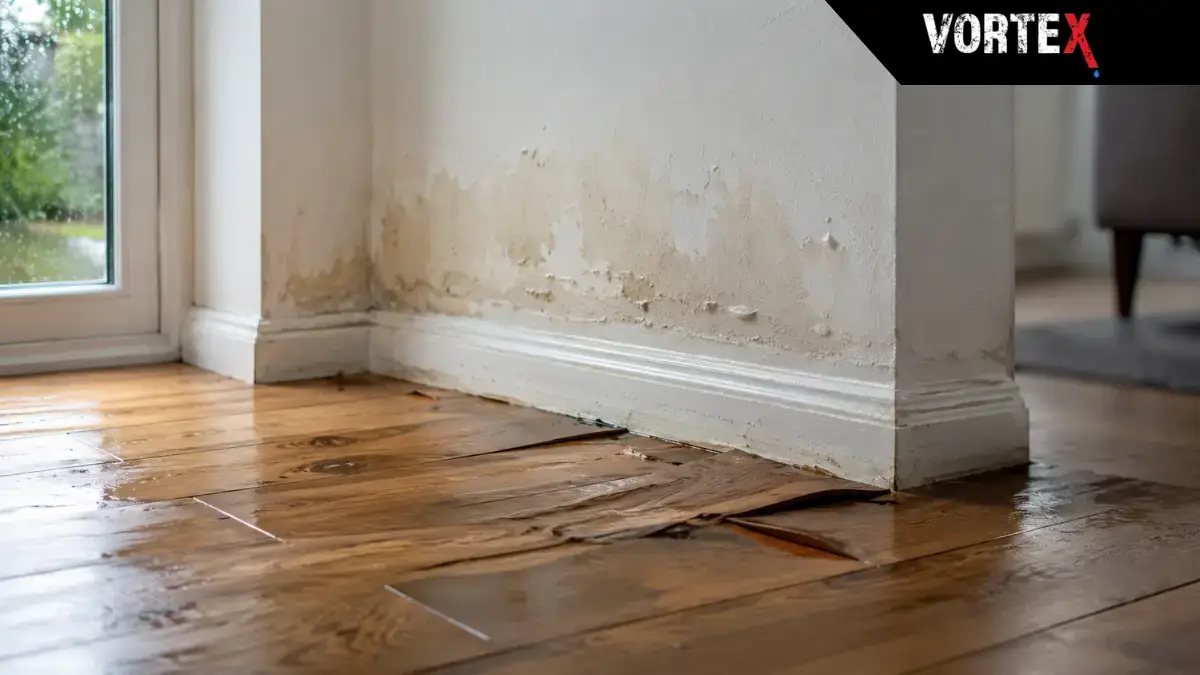

Moisture appearing on or near a floor can mean several different things, and not all of them involve a plumbing fault. For homeowners with underfloor heating, the situation becomes particularly confusing. A damp patch, a faint stain, or an area of floor that feels slightly cooler than it should all raise the same urgent question: is this my heating system leaking, or is something else causing it?
Getting this wrong has real consequences. Treating the wrong problem wastes money, delays the actual fix, and in some cases causes unnecessary damage to a floor that did not need to be opened up in the first place. Equally, dismissing a genuine underfloor heating leak as harmless condensation allows water to continue saturating the subfloor, often for months, before the damage becomes visible enough to force action.
This guide sets out clearly what distinguishes an underfloor heating leak from surface moisture, what signs point in each direction, and why professional diagnosis using non-invasive equipment is nearly always the right first step.
Why This Question Is Harder to Answer Than Most People Expect
Most people assume that a hidden water leak produces obvious, dramatic symptoms. In reality, the early stages of an underfloor heating leak are often subtle. Water escaping from a pinhole or a micro-fracture in buried pipework does not always create a visible wet patch immediately. Instead, it saturates the surrounding screed and insulation layer slowly, and the moisture only becomes visible at the surface over time, sometimes after weeks or months of ongoing loss.
Surface moisture from condensation or rising damp behaviors similarly. It appears gradually, often seasonally, and does not always produce the dramatic puddles that most people associate with a water leak.
Because both problems can look very similar at the surface level, diagnosis requires more than a visual inspection. It requires a structured approach that tests different hypotheses methodically, using the right equipment in the right sequence.
How Underfloor Heating Systems Work and Where Leaks Develop
Underfloor heating in UK properties falls broadly into two categories: wet systems and dry systems.
Wet underfloor heating systems and where leaks tend to develop
Wet underfloor heating systems circulate warm water through a network of pipes embedded in or beneath the floor. These pipes are typically made from cross-linked polyethylene or a similar flexible plastic, laid in a continuous loop connected to a manifold and fed by the property’s boiler.
Leaks in wet underfloor heating systems most commonly occur at pipe joints, at manifold connections, or at points where the pipe has been damaged during installation or subsequent work on the property. Micro-fractures caused by physical stress, corrosion at connection points, and damage from fixings or nails driven through the floor during renovations are among the most frequent causes.
In some cases, particularly in older systems, pipe degradation over time creates small weaknesses that eventually become active leaks. The water escaping from these points is under low pressure compared to mains pipework, which is partly why the leak can remain hidden for so long before symptoms become visible.
Dry systems and why moisture is rarely the same problem
Dry underfloor heating systems use electric heating elements rather than water pipes. These systems do not carry water, so a moisture problem near a dry underfloor heating installation is almost certainly coming from another source. If you have a dry system and moisture appearing on your floor, the investigation should focus on condensation, rising damp, or a plumbing leak from a nearby pipe rather than the heating system itself.
What Surface Moisture Is and Why It Mimics a Leak
Surface moisture is water that collects on or near a floor surface from causes unrelated to a plumbing or heating fault. It is one of the most commonly misdiagnosed problems in leak investigations.
Condensation on solid floors
Condensation forms when warm, humid air comes into contact with a cooler surface. In properties with solid concrete floors, particularly ground-floor rooms in older buildings, the floor surface can remain significantly cooler than the surrounding air during winter months. When warm indoor air contacts this cool surface, moisture condenses on or just beneath the surface, producing a damp appearance that can be mistaken for a plumbing leak.
This type of moisture is more common in rooms that are not well ventilated, in properties without adequate insulation beneath the floor slab, and during cold spells when the contrast between indoor air temperature and floor temperature is at its greatest.
Rising damp and ground moisture ingress
Rising damp occurs when ground moisture travels upward through the fabric of a building, typically through a wall or a floor slab that lacks an effective damp-proof membrane, or where the membrane has failed. On ground floors, rising damp can produce damp patches that appear at floor level, near skirting boards, or around the perimeter of a room.
This is particularly common in older properties built before damp-proof membranes became standard, and in properties where building work has bridged or damaged an existing membrane. In areas with high water tables, ground moisture ingress can also push moisture upward through a floor slab during periods of heavy rainfall.
Humidity-driven moisture without any plumbing cause
High indoor humidity caused by lifestyle factors such as cooking, bathing, drying clothes indoors, or poor ventilation can produce condensation on cool floor surfaces, particularly in lower ground-floor rooms and basements. This type of moisture has nothing to do with underfloor heating or any plumbing system but can produce floor-level dampness that raises understandable concern.
The Signs That Point Toward an Underfloor Heating Leak
Several symptoms are more strongly associated with a genuine underfloor heating leak than with surface moisture. None of them are definitive in isolation, but a combination of two or more should prompt a professional investigation promptly.
Unexplained drops in boiler pressure
A wet underfloor heating system is a closed circuit. If it is losing water, the pressure within that circuit will fall over time. If your boiler pressure gauge is dropping regularly without obvious explanation, and you are finding yourself topping up the system more frequently than normal, this is a meaningful indicator that water is escaping from somewhere within the heating circuit.
A pressure drop alone does not confirm where the leak is, but combined with moisture near the floor, it strengthens the case for underfloor pipework as the source.
Persistent cold spots on a floor that should be warm
In a functioning wet underfloor heating system, the floor surface should warm evenly across the heated zone. If a specific area of the floor remains consistently cool while the surrounding floor is warm, this can indicate that the pipe in that zone has been damaged and is no longer carrying heated water effectively.
A thermal imaging survey can map this temperature distribution precisely, revealing both the pipe layout and any anomalies within it.
Unexplained increases in water bills
An ongoing underfloor heating leak continuously loses water from the closed system, which means the system needs to draw in make-up water to maintain pressure. In some setups this happens automatically, meaning there is no visible pressure drop but water consumption increases instead. If your water bills have risen without an obvious explanation, a hidden leak within your heating system or elsewhere in your pipework could be the reason.
Damp patterns that appear to follow the pipe layout
If moisture is appearing at the surface in a pattern that loosely follows a grid or loop configuration, this is a strong visual indicator that the damp is following the pipe runs beneath the floor rather than spreading randomly from a surface source. This type of pattern is very difficult to produce through condensation alone and warrants urgent investigation.
Read More: How Do Specialists Find Hidden Leaks Without Damaging Your Home?
Signs That Point More Toward Surface Moisture or Condensation
Moisture appearing seasonally or only in cold weather
If the damp problem appears or worsens significantly during cold weather and improves during warmer months, this pattern is consistent with condensation or seasonal ground moisture rather than an active plumbing leak. An underfloor heating leak does not follow the seasons. It is an ongoing physical loss of water that produces moisture continuously, not selectively.
Damp concentrated near walls and skirting boards rather than across the floor
Rising damp and bridged damp-proof membranes tend to produce moisture near the perimeter of a room, along walls, and at the base of skirting boards. A heating pipe leak is more likely to produce moisture in the middle of the floor where the pipe runs are located. If the damp is consistent with the perimeter rather than the central heating zone, a non-plumbing cause becomes more likely.
No change in heating system performance or pressure
If the boiler pressure is stable, the floor is heating evenly, and there are no cold spots or performance issues with the underfloor system, the heating circuit itself is probably not the source of the moisture. In this scenario, a condensation, rising damp, or ground moisture investigation becomes the priority.
Why DIY Checks Are Not Reliable Enough
Several online resources suggest that homeowners can diagnose a floor moisture problem by taping a piece of polythene sheeting to the floor and checking whether moisture forms on the surface or underneath it. While this test can offer a rough indication of whether moisture is coming from above or below the floor, it has significant limitations.
It cannot identify whether moisture from below is caused by a plumbing leak, ground moisture, or a failed damp-proof membrane. It cannot map the extent of moisture within the floor structure. It cannot confirm whether a heating pipe is actively losing water. And it produces no evidence suitable for an insurance claim or a structural assessment.
For a floor moisture problem involving underfloor heating, a professional investigation using calibrated equipment is not an optional extra. It is the only way to get an accurate diagnosis without unnecessary physical disruption to the floor.
How Professionals Distinguish Between the Two
Specialist leak detection engineers use a combination of diagnostic methods that are non-invasive, precise, and capable of confirming or ruling out a heating leak before any floor covering is lifted.
Thermal imaging cameras
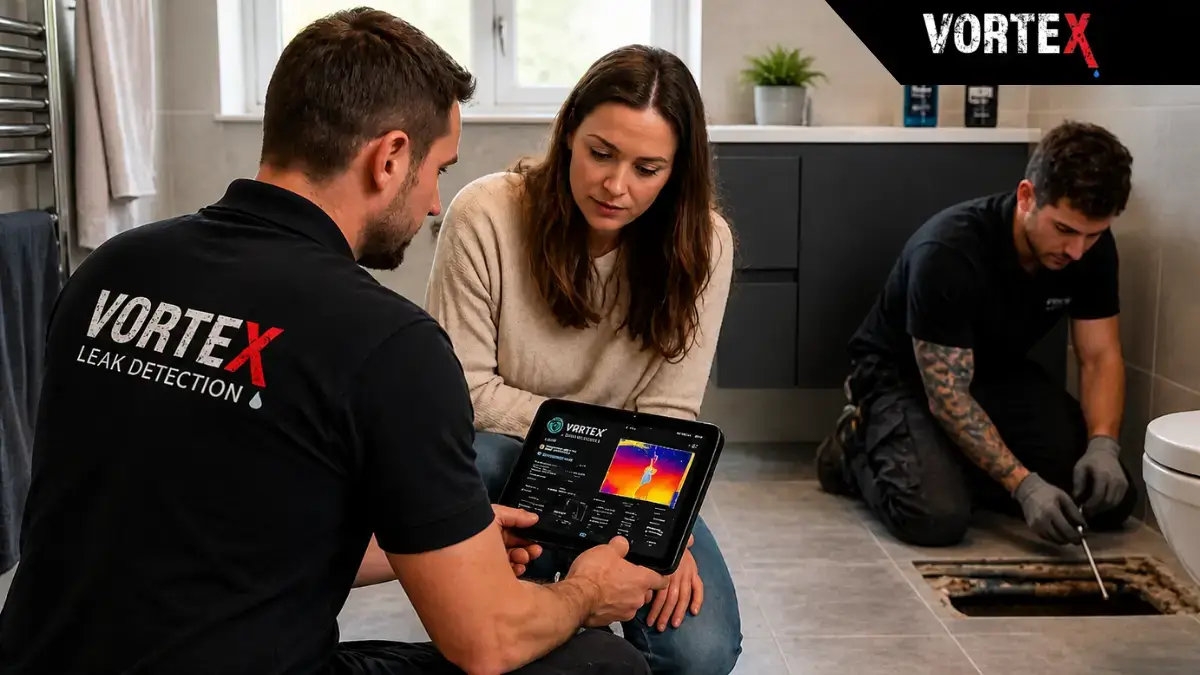
A thermal imaging camera captures the heat signature of the floor surface and displays it as a colour-coded image. Because wet underfloor heating pipes emit heat, their position within the floor is visible on a thermal image when the system is operating. If a pipe is leaking, the heat distribution in that area changes, producing an anomaly that is visible and mappable. Moisture saturation also has its own thermal signature, which experienced engineers can identify and interpret correctly.
This is one of the most powerful diagnostic tools for underfloor heating leaks because it requires no physical access to the pipework and produces clear, documentable evidence. The thermal imaging and other specialist detection equipment used by our team is detailed on our technology page.
Moisture meters and salts testing
A moisture meter measures the relative moisture content of a material without needing to cut into it. When used across a floor surface, it can map areas of elevated moisture and indicate whether the moisture distribution is consistent with a plumbing leak or with surface condensation and rising damp.
Salts testing adds an additional layer of analysis. Ground moisture and rising damp carry different salts to the surface compared with fresh water from a heating system. A salts analysis can help confirm whether the moisture present is from a plumbing source, which is significant when both a heating leak and rising damp are being considered simultaneously.
Pressure testing the heating circuit
One of the most direct tests for a wet underfloor heating leak is to pressure-test the heating circuit itself. By isolating the system and applying a controlled test pressure, engineers can confirm whether the circuit is holding pressure or losing it. A sustained pressure drop under test conditions confirms that the circuit has a leak, even if the location has not yet been pinpointed.
This test is straightforward, non-invasive, and provides clear binary evidence that either supports or eliminates the heating system as a source of moisture.
Tracer gas leak detection
For locating the precise position of a leak within underfloor pipework, tracer gas is one of the most accurate methods available. A safe, inert gas mixture is introduced into the pipe circuit under pressure. The gas migrates through any breach in the pipe and rises through the floor material toward the surface, where it is detected using a handheld probe sensitive enough to identify concentrations in parts per million.
This method can pinpoint a leak to within a very small area, which means that when the floor does need to be opened for repair, only the relevant section needs to be accessed. This saves significant time, money, and disruption compared with opening up large areas of floor on a best-guess basis. Our team uses tracer gas as part of our professional trace and access service across a wide range of property types, including those with complex or retrofit underfloor systems.
What Happens When the Wrong Problem Gets Treated
Misdiagnosis has real costs. A homeowner who treats condensation with improved ventilation but actually has an underfloor heating leak will continue to experience moisture problems and ongoing water loss. The leak will worsen. The screed will become increasingly saturated. Mould may begin to develop within the floor structure. Floor finishes will degrade. And when the problem eventually becomes impossible to ignore, the repair cost will be substantially higher than it would have been if the correct diagnosis had been made earlier.
Conversely, a homeowner who opens up a floor looking for a heating pipe leak, when the actual problem is rising damp, has incurred unnecessary disruption and cost, and still has rising damp to address afterward.
In properties across London, Hertfordshire, Essex, and the wider South East, we regularly carry out investigations where previous attempts at self-diagnosis or misguided remediation have made the situation more difficult to resolve. The pattern is consistent: the longer the correct diagnosis is delayed, the more complex and costly the outcome tends to be.
Insurance Claims and Why an Accurate Diagnosis Matters
Many home insurance policies include cover for escape of water, which can include underfloor heating leaks. However, insurers consistently require professional evidence confirming the source, location, and nature of the leak before authorising a claim or funding repairs.
A professional leak detection report that sets out the diagnostic methods used, the findings, and the confirmed location of the leak provides exactly the evidence insurers need. A vague assessment, a self-diagnosis, or an assumption is unlikely to support a successful claim. Our report writing service is specifically designed to produce documentation that meets insurer requirements, giving homeowners and their loss adjusters a clear, verifiable basis for the claim.
If you suspect a leak, contacting a specialist before contacting your insurer is advisable. A confirmed, professionally documented leak diagnosis puts you in a significantly stronger position from the outset.
What to Do If You Suspect a Problem Beneath Your Floor
The practical steps are straightforward. Check your boiler pressure gauge. Note whether it has been dropping and how frequently you have needed to repressurise the system. Observe the damp area carefully and note whether it is concentrated in the middle of the floor or at the perimeter, whether it appears in patterns or spreads randomly, and whether it changes with the weather or the seasons.
Then contact a specialist. Non-invasive underfloor heating leak detection is a defined, methodical process that does not require tearing up your floor to get started. In most cases, a professional visit using thermal imaging, moisture assessment, and pressure testing will provide a clear diagnosis within a single appointment.
If you have noticed moisture near your floor, unexplained pressure drops in your heating system, or an area of your floor that simply does not heat correctly, a home plumbing survey or a targeted leak detection investigation is the right next step. Catching the problem early, diagnosing it correctly, and repairing only what needs to be repaired is always more cost-effective than acting late on assumptions.
If you would like to arrange a specialist inspection, contact our team to discuss your situation and book a survey at a time that suits you.
Vortex Leak Detection are UK specialists in non-invasive hidden water leak detection for domestic and commercial properties. Our team uses advanced thermal imaging, tracer gas, acoustic detection, and pressure testing to locate leaks accurately without unnecessary disruption. We cover properties across the UK including London, Hertfordshire, Essex, Surrey, Kent, Bedfordshire, and beyond.
You may also like: What Are the Earliest Signs of a Hidden Heating Leak?