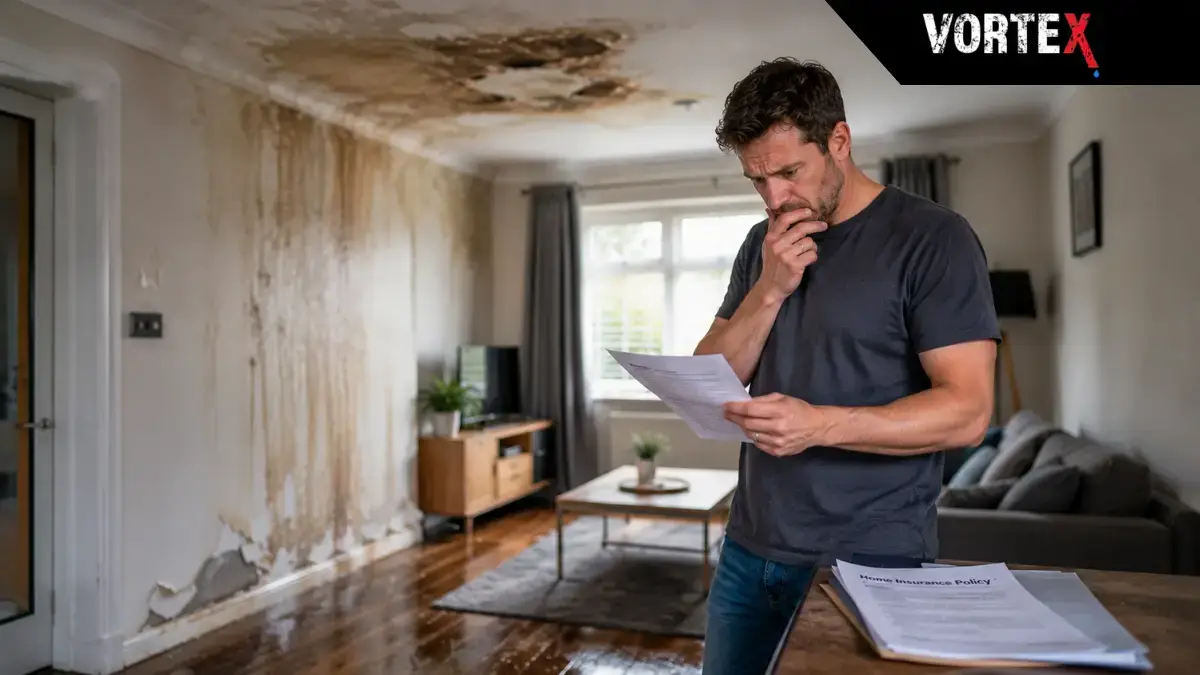

Damp walls in a rented property are one of the most common and most disputed property maintenance issues in the UK. Landlords frequently attribute the problem to tenant behaviour: inadequate ventilation, drying clothes indoors, failing to heat the property sufficiently. Tenants frequently attribute it to structural problems: a leaking pipe, failed insulation, an ageing building that the landlord has not maintained properly. In many cases, both parties have some basis for their position. In others, one party is clearly correct and the other is not.
Understanding which type of damp is present, who bears legal responsibility for it, and what the correct process for resolving it looks like is essential for both landlords and tenants. This article provides clear guidance on all three questions, with appropriate qualifications where the law or the facts may vary.
| Quick AnswerResponsibility for damp in a rented property depends on the type of damp. Condensation caused by tenant behaviour such as inadequate ventilation is generally the tenant’s responsibility to manage. Structural damp from a failed damp-proof course, penetrating damp, or a hidden water leak is generally the landlord’s responsibility to investigate and repair. A specialist report distinguishing the type of damp is the most effective tool for resolving disputes. |
Why Damp in Rented Properties Creates Disputes
The core of the dispute is diagnosis. Condensation damp and leak-caused damp look similar on a wall surface. Both produce staining, mould, and moisture. Without specialist assessment, each party can point to the appearance of the damp and support their preferred explanation.
Landlords have a financial incentive to attribute damp to tenant behaviour because that characterisation reduces or eliminates their repair obligation. Tenants have an interest in attributing it to structural causes because that places the obligation on the landlord. In some cases these interests align with reality. In others they distort it. The factual question of what type of damp is present, and what is causing it, is the question that a professional moisture assessment or specialist leak investigation answers objectively.
The Three Types of Damp and Who Is Responsible for Each
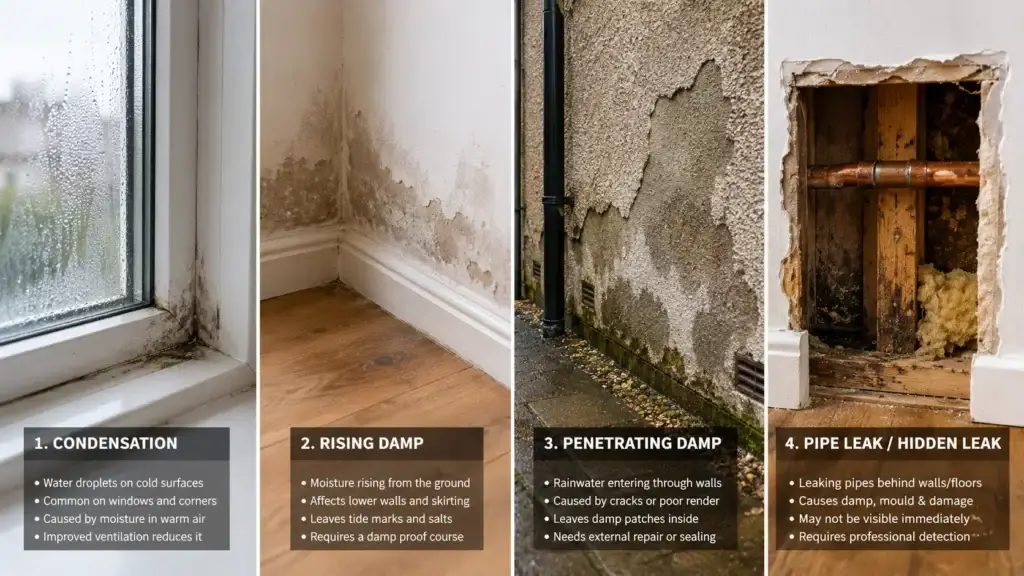
| Type of Damp | Typical Cause | Responsible Party | Action Required |
| Condensation | Insufficient ventilation, high moisture generation, inadequate heating. Related to how the property is occupied. | Tenant if caused by inadequate ventilation and heating; landlord if the property lacks adequate ventilation provision or insulation | Improved ventilation by tenant; landlord may need to provide mechanical ventilation or improve insulation |
| Rising damp | Failed or absent damp-proof course allowing ground moisture to travel up through masonry | Landlord. A structural defect in the building is the landlord’s responsibility to repair | Landlord to commission damp-proofing treatment and repair |
| Penetrating damp | Water entering from outside through failed pointing, cracked render, blocked gutters, or failed flashings | Landlord. External fabric defects are the landlord’s responsibility | Landlord to repair the external fault causing water ingress |
| Hidden water leak | Pipe leak within walls, floors, or ceilings saturating building fabric and causing damp | Landlord. A structural pipe failure is the landlord’s responsibility to investigate and repair | Landlord to arrange specialist detection and repair |
What Landlords Are Legally Required to Do About Damp
In England and Wales, landlords have a legal obligation under the Landlord and Tenant Act 1985 to keep the structure and exterior of the property in repair, including the roof, walls, floors, ceilings, and the installations for the supply of water, gas, and electricity. This obligation applies regardless of the duration of the tenancy.
Since 2019, the Homes (Fitness for Human Habitation) Act requires landlords to ensure that properties are fit for human habitation at the start of and throughout the tenancy. Severe damp and mould that presents a health hazard is explicitly within the scope of this act. A property with significant mould from a structural leak that has not been addressed may be considered unfit for human habitation.
Since 2021, the Decent Homes Standard and subsequent guidance from the Regulator of Social Housing has strengthened requirements around damp and mould for social housing landlords specifically. Private landlords are subject to the Landlord and Tenant Act and the Fitness for Human Habitation Act provisions.
Importantly, the legal obligation is to investigate as well as to repair. A landlord who attributes damp to condensation without investigation and takes no further action, when the actual cause turns out to be a structural defect, may be in breach of their repairing obligations. The correct response to a damp complaint from a tenant is to investigate the cause properly, not simply to advise the tenant to open more windows.
| Note on legal scope:This article provides general guidance only and does not constitute legal advice.Specific rights and obligations vary by tenancy type, lease terms, andjurisdiction. Tenants or landlords with complex disputes should seekindependent legal advice from a solicitor with housing law expertise. |
What Tenants Can and Cannot Be Held Responsible For
Tenants have a general responsibility to use the property in a tenant-like manner, which includes adequate ventilation of the property. In practice, this means running extractor fans in bathrooms and kitchens, opening windows periodically, not blocking ventilation points, and not generating significantly more moisture than a property is designed to manage.
What tenants cannot be held responsible for: structural defects that allow water to enter or travel through the building, pipe failures within the walls, floors, or ceilings, rising or penetrating damp, inadequate insulation built into the property, and any form of damp that is caused by the physical condition of the building rather than the behaviour of the occupant.
A tenant who ventilates adequately, heats consistently, and does not generate abnormal levels of moisture cannot be held responsible for condensation mould if it still develops, because the cause at that point is the building’s physical condition rather than the tenant’s behaviour.
How to Tell the Difference Between Tenant-Caused Condensation and a Structural Leak
This is the diagnostic question at the heart of most damp disputes in rented properties. Condensation mould and leak-caused damp look similar on a wall. They can both be present simultaneously. But they have different positions, different patterns, and different responses to ventilation management.
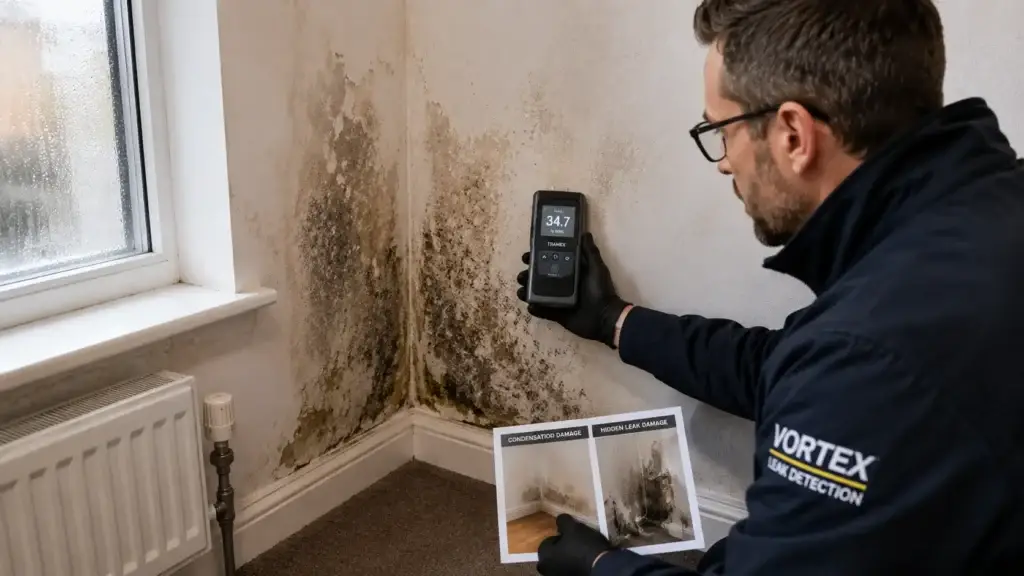
Condensation mould appears high on walls, in corners, around windows, and on cold external surfaces. It improves when ventilation increases. It is worst in winter and in rooms with high moisture generation. These characteristics are consistent with condensation as the primary cause.
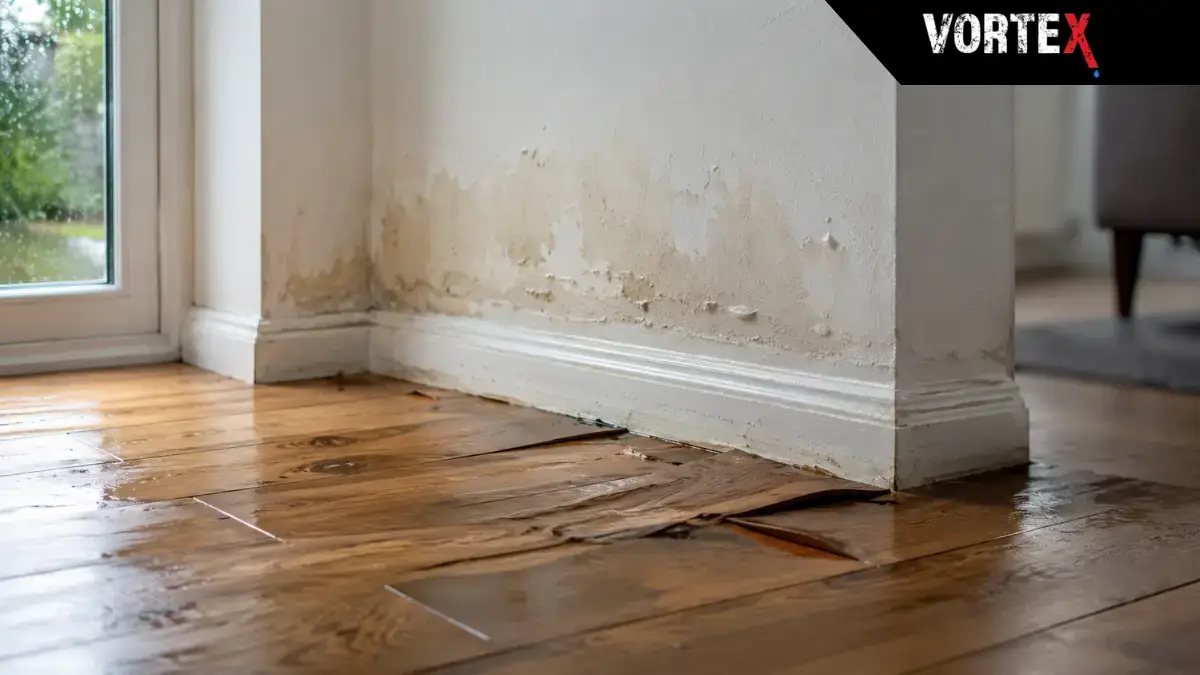
Damp from a hidden leak appears at low levels on walls, near skirting boards, on internal walls not associated with cold surfaces, behind fitted furniture, and in areas that do not correspond to condensation zones. It does not improve with ventilation. It may have a musty or earthy smell. It may be associated with recurring boiler pressure loss or a rising water bill.
Where both types may be present simultaneously, a specialist moisture assessment with a calibrated moisture meter can measure the actual moisture content of the building material at different points and depths, helping to distinguish between surface condensation moisture and moisture from within the building fabric.
Why a Specialist Report Resolves Disputes Faster Than Anything Else
In a damp dispute between a landlord and a tenant, a specialist report that objectively identifies the type and cause of the damp is the most efficient route to resolution. Without it, both parties present their interpretation of the same visible evidence. With it, the cause is documented by a professional with no stake in the outcome.
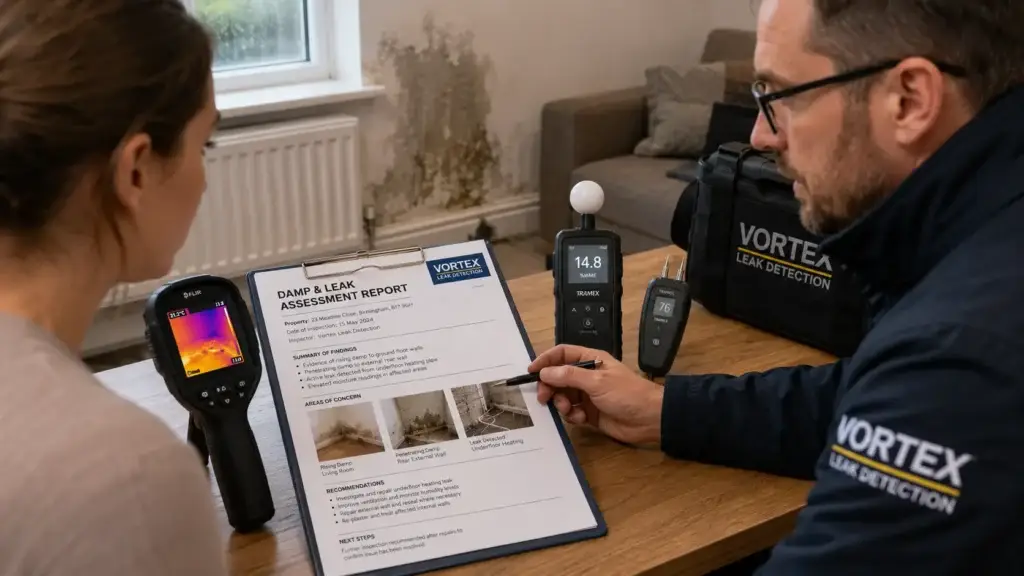
If the report confirms condensation as the primary cause, the landlord has documented grounds for the tenant to improve ventilation management. If the report confirms a hidden leak or structural damp, the landlord has a documented obligation to investigate and repair. In either case, the dispute is shifted from an argument about interpretation to a response to evidence.
For landlords managing multiple properties or dealing with a tenant who is making a formal complaint to the council or tribunal, a specialist report is also important protection. It demonstrates that the landlord has taken the complaint seriously and commissioned a proper investigation rather than simply dismissing the complaint.
The Process When a Hidden Leak Is Suspected in a Rented Property
When damp in a rented property appears consistent with a hidden pipe leak rather than condensation, the appropriate process involves the following steps. The tenant reports the damp in writing to the landlord, describing its location, extent, and any other symptoms such as a musty smell or associated boiler pressure loss. The landlord acknowledges the complaint within a reasonable timeframe and arranges for an investigation.
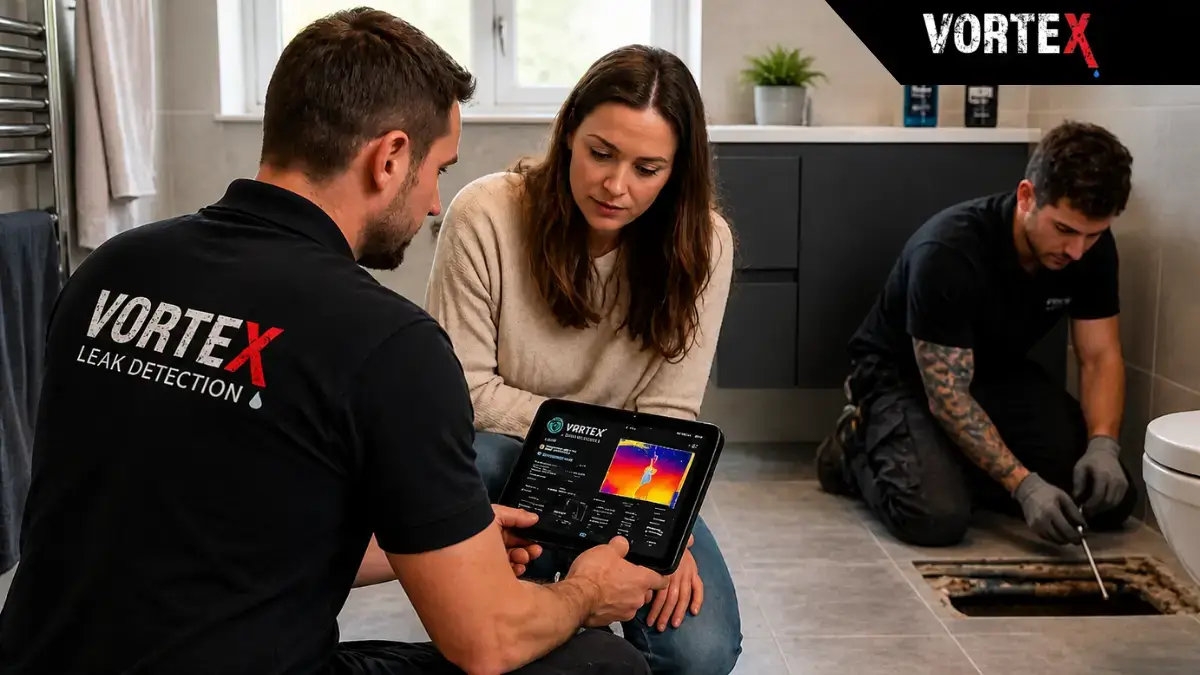
The investigation should include a specialist moisture assessment and, where a hidden leak is suspected, a specialist leak detection survey. The landlord is responsible for commissioning and funding this investigation. The tenant should allow reasonable access for the survey to be carried out. The survey results are provided in writing and form the basis for any required repair.

If a hidden leak is confirmed, the landlord arranges the repair through a qualified plumber and the subsequent drying and reinstatement of the affected area. The timescale for this should be reasonable given the nature of the work, but unreasonable delay by a landlord with a confirmed structural leak is a potential breach of their legal obligations.
What Happens If the Landlord Does Not Act?
If a landlord does not respond appropriately to a damp complaint, tenants have several escalation options. They can contact the local council’s environmental health department, which has powers to inspect properties and issue improvement notices requiring landlords to carry out repairs. They can raise a complaint with a landlord redress scheme if the landlord is a member of one. In serious cases they may apply to the First Tier Tribunal (Property Chamber) for a determination of the landlord’s obligations.
A specialist report confirming a structural damp cause significantly strengthens the tenant’s position in any of these escalation routes by providing objective evidence that the damp is not attributable to tenant behaviour.
What Landlords Should Do Before Blaming Tenants for Damp
The instinct to attribute all damp to tenant behaviour is legally and practically risky for landlords. If a landlord dismisses a legitimate damp complaint as condensation without investigation, and it later transpires that a hidden leak was the cause, the landlord may face liability for the period during which the complaint was ignored.
The correct response to any damp complaint is to investigate it properly. Commission a moisture assessment. If a hidden leak is a possibility, commission a specialist detection survey. Document the investigation and the findings. Respond to the tenant with the outcome and the planned repair timeline if a structural issue is found.
This approach protects the landlord legally, maintains the landlord-tenant relationship, and prevents the structural damage from compounding during a prolonged dispute. It is also the approach most likely to resolve the situation without escalation to council involvement or tribunal proceedings.
Quick Reference: Responsibility by Damp Type
| Damp Type | Landlord’s Obligation | Tenant’s Obligation |
| Condensation from ventilation | Provide adequate ventilation in the property. May need to upgrade if property is inherently prone. | Ventilate adequately, heat consistently, manage moisture generation |
| Rising damp | Investigate and repair damp-proof course. Arrange specialist treatment. | Report the damp. Allow access for investigation and repair. |
| Penetrating damp | Repair external defect causing water ingress (roof, gutters, pointing, render) | Report the damp. Allow access for external inspection and repair. |
| Hidden pipe leak | Arrange specialist detection and repair. Fund the investigation. | Report symptoms promptly. Allow access for investigation. |
| Combined condensation and leak | Address the structural element. Cannot require tenant to manage condensation that is exacerbated by a structural fault. | Improve ventilation for the condensation element once structural cause is repaired. |
What to Do Next
If you are a landlord dealing with a damp complaint in a rental property, or a tenant experiencing damp that you believe is caused by a structural problem, Vortex Leak Detection provides specialist moisture assessment and hidden leak investigation services. A written report from the survey provides the objective evidence that both parties need to resolve the dispute and determine the correct course of action.
Get in touch to discuss your situation and arrange an assessment.